Asphalt Calculator
This asphalt calculator turns length, width and compacted thickness into tons of hot mix. A 40 × 12 ft driveway paved 3 in thick holds 120 cubic feet of asphalt; with 5% extra, that's about 9.2 tons (8.95–9.45 tons, depending on the mix's density).
Example: 40 × 12 ft at 3 in
9.2 tons
- 4.67 cu yd
- 126 cu ft
8.95–9.45 tons (range of densities) · 4.67 yd³ incl. 5% extra
How to calculate asphalt tonnage
Paving quantities are worked out by weight, so the number you’re after is tons. Measure the area in feet and multiply length × width for square feet, then multiply by the compacted thickness in inches divided by 12 to get cubic feet. Multiply that by what compacted hot mix weighs (142–150 lb per cubic foot in the Asphalt Institute and state transportation department figures behind this page) and divide by 2,000. The calculator handles rectangles, circles, rings, triangles and L-shapes, accepts a square footage you already know, and totals several areas. Blacktop is the everyday name for the same material, so this also works as a blacktop calculator.
Paving manuals often skip cubic feet and use a spread rate: pounds of asphalt per square yard per inch of thickness. Asphalt magazine’s rules of thumb, written by Asphalt Institute engineers, give 110 lb as the typical rate, and the Illinois and Wisconsin transportation departments estimate with 112 lb. At 110 lb, tons = square yards × inches × 110 ÷ 2,000. The two methods agree, because 110 lb per square yard per inch works out to 146.7 lb per cubic foot, the typical weight the calculator uses for its headline number.
- Area: 40 ft × 12 ft = 480 sq ft; × 3 in deep = 120 cu ft.
- 120 cu ft ÷ 27 = 4.44 cubic yards.
- Adding 5% extra for waste gives 4.67 cubic yards.
- Rounded up to the next 0.5 cubic yard: order 5 cubic yards.
- Weight of hot mix asphalt: 8.95–9.45 tons, depending on moisture and grading.
The spread rate gives the same answer: 480 sq ft is 53.3 square yards, and 53.3 × 3 in × 110 lb = 17,600 lb, or 8.8 tons before the 5% extra. For hot mix, compare the tonnage line with your quote. The half-yard rounding in the example only matters if a supplier sells by the cubic yard.
How much does 1 ton of asphalt cover?
A ton of hot mix covers 53–56 square feet at 3 inches, or about 6 square yards. Thinner layers spread further: at 2 inches the same ton covers 80–85 square feet. To estimate tons from an area, divide the square feet by the coverage at your thickness. The 480 sq ft driveway above, at about 54.5 sq ft per ton, needs 8.8 tons before extra.
| Depth | 1 cubic yard covers | 1 ton of hot mix asphalt |
|---|---|---|
| 2 in | 162 sq ft | 80–85 sq ft |
| 2.5 in | 130 sq ft | 64–68 sq ft |
| 3 in | 108 sq ft | 53–56 sq ft |
| 4 in | 81 sq ft | 40–42 sq ft |
Per-ton coverage spans the sourced density range: heavier material covers less.
Asphalt tons for common driveway sizes
These run from a 10 × 20 ft parking pad to a 100 × 20 ft driveway (2,000 sq ft), at four compacted thicknesses. Each cell leads with tons of hot mix, with the volume rounded up to the next half cubic yard underneath.
| Area | 2 in thick | 2.5 in thick | 3 in thick | 4 in thick |
|---|---|---|---|---|
| 10 × 20 ft, 200 sq ft | 2.5–2.6 t , 1.5 yd³ | 3.1–3.3 t , 2 yd³ | 3.7–3.9 t , 2 yd³ | 5–5.3 t , 3 yd³ |
| 20 × 20 ft, 400 sq ft | 5–5.3 t , 3 yd³ | 6.2–6.6 t , 3.5 yd³ | 7.5–7.9 t , 4 yd³ | 9.9–10.5 t , 5.5 yd³ |
| 40 × 12 ft, 480 sq ft | 6–6.3 t , 3.5 yd³ | 7.5–7.9 t , 4 yd³ | 8.9–9.5 t , 5 yd³ | 11.9–12.6 t , 6.5 yd³ |
| 24 × 24 ft, 576 sq ft | 7.2–7.6 t , 4 yd³ | 8.9–9.5 t , 5 yd³ | 10.7–11.3 t , 6 yd³ | 14.3–15.1 t , 7.5 yd³ |
| 100 × 20 ft, 2,000 sq ft | 24.9–26.3 t , 13 yd³ | 31.1–32.8 t , 16.5 yd³ | 37.3–39.4 t , 19.5 yd³ | 49.7–52.5 t , 26 yd³ |
Includes 5% extra, rounded up to the next half cubic yard, as the calculator does. Tons (t) span the sourced density range.
How thick should asphalt be for a driveway?
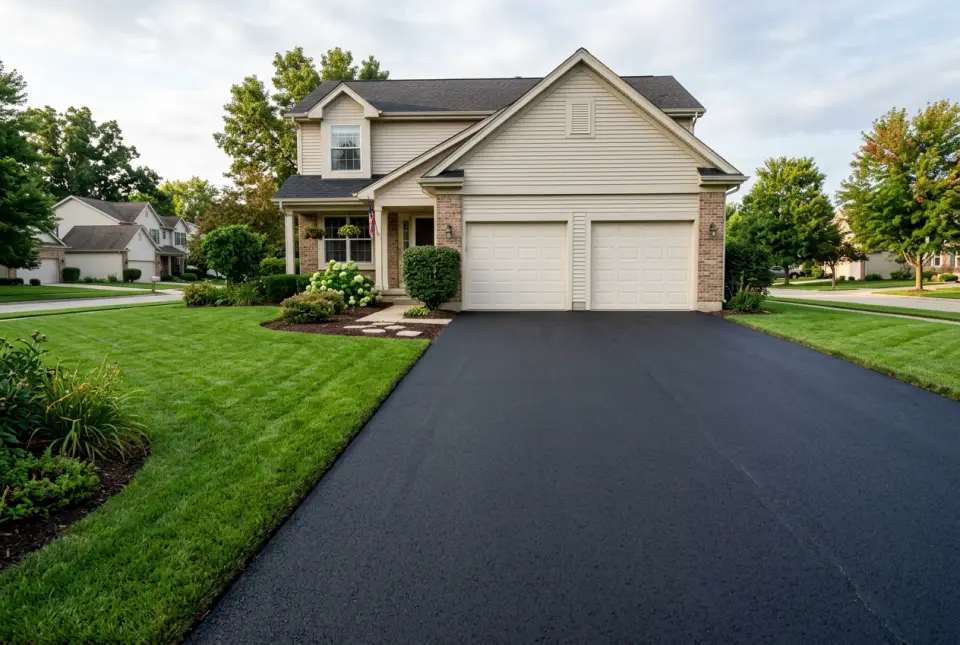
The Asphalt Pavement Association of Oregon’s paving design guide gives 2.5 inches of compacted asphalt, placed in one lift, for driveways and private roads with very light traffic. What goes under it depends on the soil, which engineers call the subgrade. On excellent subgrade the guide calls for 4 inches of aggregate base, on good subgrade 8 inches, and on fair subgrade 12 inches. The guide describes these as average compacted thicknesses for paving in the dry season.
The calculator’s example uses 3 inches, half an inch more than that table. Your local code or paving contractor may call for a different thickness, so enter the compacted thickness written on your quote. If the quote doesn’t say whether its thickness is compacted, ask; the next section explains why it matters.
Loose vs compacted thickness
Hot asphalt goes down thicker than it finishes. The paving machine lays a loose mat and the roller presses it down, so crews spread it 20–25 percent thicker than the planned final depth, according to the New York State and Alaska transportation departments and Asphalt Institute engineers. A driveway meant to finish at 3 inches is laid about 3.6 to 3.75 inches deep.
Rolling pushes air out of the mat without changing the amount of asphalt in it. The weights on this page are for compacted, in-place hot mix, so the calculator asks for the finished thickness; entering the loose depth by mistake would overstate the tons by 20–25%.
The gravel base under asphalt
Asphalt sits on a compacted aggregate base. In the Oregon table above the base is always thicker than the asphalt, so it’s usually the larger order. Crusher run, crushed stone mixed with its own fines, is used for driveway bases, and it packs down by a third or more, so the order is for the loose volume. For the same driveway at 8 inches, the guide’s figure for good subgrade, the base works out like this:
- Area: 40 ft × 12 ft = 480 sq ft; × 8 in deep = 320 cu ft.
- 320 cu ft ÷ 27 = 11.9 cubic yards.
- Adding 33% for compaction and 5% extra for waste gives 16.6 cubic yards.
- Rounded up to the next 0.5 cubic yard: order 17 cubic yards.
- Weight of crusher run: 20.1–24.8 tons, depending on moisture and grading.
On excellent subgrade (4 inches) the order drops to 8.5 cubic yards, and on fair subgrade (12 inches) it rises to 25. The “Gravel for the base” link in the calculator’s Next list opens the gravel calculator with your area already entered, so you only change the depth and the stone.
Asphalt millings: lighter by the yard
Millings are recycled asphalt pavement, ground up and sold loose for driveways. Loose and dry, they weigh 1.13–1.24 tons per cubic yard in a Wisconsin DOT research study, against 1.92–2.03 tons per cubic yard for compacted hot mix. Rolled, the same recycled base reached 1.64–1.71 tons per cubic yard in that study, and it grew 35–46% in volume going from compacted back to loose.
The calculator’s millings weight is for loose material, so with “Asphalt millings” picked, enter the depth you’ll spread before rolling. For a layer that should roll down to 3 inches, that’s roughly 4 to 4.4 inches loose. Compacted 3 inches deep on the 40 × 12 ft driveway, millings come to 7.3–7.6 tons, compared with 8.5–9.0 tons of hot mix.
What asphalt costs
Asphalt prices vary by region. The asphalt driveway cost guide covers what a paved driveway costs. If you already have a price per ton, open “Add your local price” in the calculator, choose “ton”, and it multiplies your tonnage out, with a delivery fee if you add one.
Questions people ask
How do I calculate how much asphalt I need?
Multiply length × width in feet for square feet, then multiply by the compacted thickness in inches ÷ 12 for cubic feet. Multiply that by the weight of compacted hot mix, 142–150 lb per cubic foot, and divide by 2,000 for tons. Add about 5% for waste. A 40 × 12 ft driveway at 3 inches is 120 cubic feet, or 8.5–9.0 tons before the extra.
How much does 1 ton of asphalt cover 3 inches thick?
About 53–56 square feet, or roughly 6 square yards. One square foot of compacted hot mix 3 inches thick weighs 35.5–37.5 lb, so a 2,000 lb ton stretches a little further with a lighter mix. At 2 inches a ton covers 80–85 sq ft, and at 4 inches 40–42 sq ft.
How many tons of asphalt do I need for 2,000 square feet?
At 3 inches compacted, 2,000 sq ft is 500 cubic feet of asphalt: 35.5–37.5 tons, or 37.3–39.4 tons with 5% extra. At 2 inches it's 23.7–25.0 tons before the extra. The asphalt driveway cost guide on this site turns that tonnage into a price.
How much asphalt do I need for a 20x20 driveway?
A 20 × 20 ft pad is 400 sq ft. At 3 inches compacted that's 100 cubic feet, or 7.1–7.5 tons of hot mix, and 7.5–7.9 tons with 5% extra. At 2.5 inches it's 5.92–6.25 tons before the extra. To price it, multiply the tons by the price per ton on your quote.
How thick should an asphalt driveway be?
The Asphalt Pavement Association of Oregon's design guide gives 2.5 inches of compacted asphalt for driveways with very light traffic. Under it goes an aggregate base of 4 inches on excellent subgrade soil, 8 inches on good and 12 inches on fair. Your local code or contractor may call for a different thickness, so enter the compacted thickness from your quote.
Is blacktop the same as asphalt?
In everyday use, yes. Blacktop is the common name for asphalt pavement, a mix of aggregate and asphalt binder laid hot and rolled. This works as a blacktop calculator too: enter the area and the compacted thickness and read the tons.
How much do asphalt millings weigh?
Loose and dry, millings weigh about 1.13–1.24 tons per cubic yard (84–92 lb per cubic foot), from Wisconsin DOT tests on recycled asphalt base. Rolled, the same material reached 1.64–1.71 tons per cubic yard. Compacted hot mix weighs 1.92–2.03 tons per cubic yard, so millings are the lighter material either way.
Sources
- Asphalt Pavement Association of Oregon, Asphalt Paving Design Guide (Hicks, Curren & Lundy, 1998; revised Oct 2003 by J. Huddleston). Accessed Oct 19, 2026.
- Asphalt Institute, Engineering FAQs. Accessed Oct 19, 2026.
- New York State Department of Transportation, Construction Inspection Manual, Section 402 - Hot Mix Asphalt (HMA) Pavements (February 2019). Accessed Oct 19, 2026.
- Asphalt magazine (Asphalt Institute trademark; authors are Asphalt Institute engineers), Five handy rules of thumb for successful asphalt pavement construction (Gierhart & Wielinski, Sept 11, 2023). Accessed Oct 19, 2026.
- Illinois Department of Transportation, District 1, HMA Mix Selection Guide 2023 (District One Hot-Mix Asphalt Mixture Treatments, revised 6/1/2023). Accessed Oct 19, 2026.
- Wisconsin Department of Transportation, Construction and Materials Manual, Section 459 Asphalt Mat Inspection (April 2026). Accessed Oct 19, 2026.
- Wisconsin DOT / Wisconsin Highway Research Program (Michigan State Univ. & Univ. of Wisconsin-Madison), Weight-Volume Relationships and Conversion Factors for Soils and Aggregates of Wisconsin (WHRP G22-05 Final Report, Dec 2023). Accessed Oct 19, 2026.
- Alaska Department of Transportation & Public Facilities, Asphalt Pavement Inspector's Manual, Chapter 6: Laydown. Accessed Oct 19, 2026.
- T.H. Kinsella, Inc. (Kinsella Quarries), Fayetteville, NY, Project Calculator - Materials & Pricing Estimates. Accessed Oct 19, 2026.
- Penn State Center for Dirt & Gravel Road Studies, Estimating Quantities and Costs (DGLVR Program webinar slides, 2/16/2023). Accessed Oct 19, 2026.