Firewood Calculator
This firewood calculator turns a stack's length, height and piece length into full cords, face cords and cubic feet. A stack 16 ft long and 4 ft high of 16-inch logs is 85.3 cubic feet: two-thirds of a full cord (128 cubic feet), or two face cords.
Example: 16 ft × 4 ft stack of 16 in wood
0.67 full cords
- 2 face cords of 16 in wood
- 85.3 cu ft
85.3 cu ft ÷ 128 cu ft per cord · one face cord here is 0.33 cord
How to measure a stack of firewood
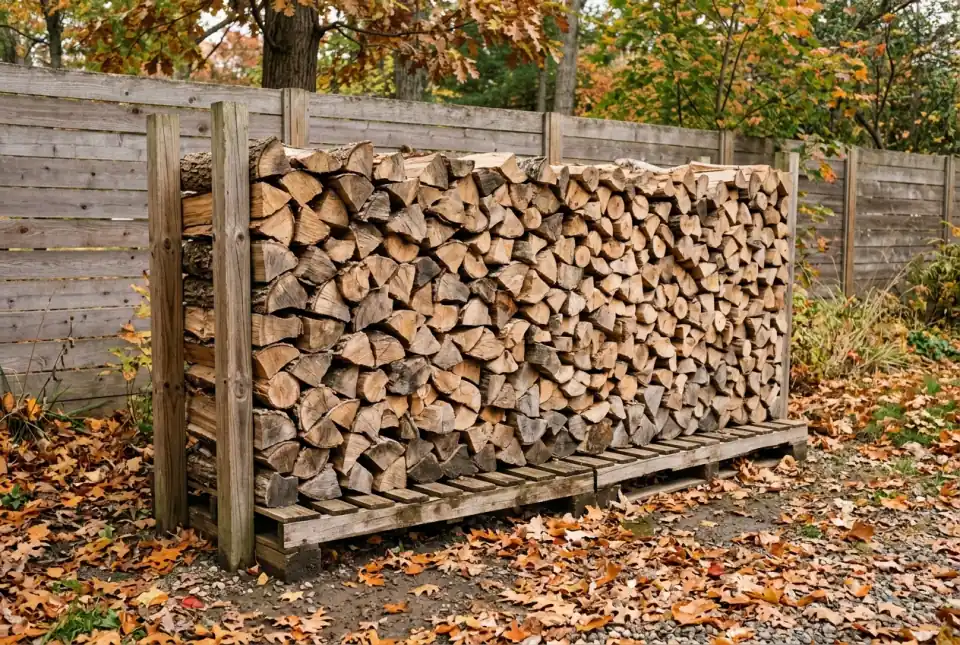
A cord is a volume: 128 cubic feet of wood “ranked and well stowed.” NIST Handbook 130, the model regulation states can adopt for selling firewood, defines that as pieces laid in a row, touching and parallel to each other, and stacked compactly. Three measurements tell you how much of a cord your stack holds:
- The length of the stack, end to end.
- The height, from the lowest piece to the top of the wood. If the stack sits on pallets or a rack, leave out the space underneath.
- The piece length, which is also the depth of a single row. Measure a few pieces and use the typical length. The University of Wisconsin’s forestry extension notes that firewood is commonly cut to 16 inches.
Multiply the three, in feet, for cubic feet, and divide by 128 for full cords. Face cords only need the front of the stack: length × height ÷ 32, because one face cord is a 4 × 8 ft face.
Here is the calculator’s example worked by hand, a stack 16 ft long and 4 ft high of 16-inch wood:
| Step | Arithmetic | Result |
|---|---|---|
| Face of the stack | 16 ft × 4 ft | 64 sq ft |
| Volume | 64 sq ft × 1.333 ft (16 in ÷ 12) | 85.33 cu ft |
| Full cords | 85.33 ÷ 128 | 0.67 cord (two-thirds) |
| Face cords | 64 ÷ 32 | 2 face cords of 42.67 cu ft each |
The calculator does the same arithmetic as you type, in feet and inches or in metric, and prints the cubic feet behind the answer so you can check it.
Cords and face cords by piece length
Face cords count the front of the stack, so a 16 × 4 ft stack is two face cords whether the pieces are 12 or 24 inches long. The wood behind that face grows with the piece length, and so does the share of a full cord, so two sellers can both deliver “two face cords” while one of them brings twice as much wood.
| Piece length | 16 × 4 ft stack | Full cords | Face cords | Row 4 ft high that makes 1 full cord |
|---|---|---|---|---|
| 12 in | 64 cu ft | 0.5 | 2 | 32 ft long |
| 16 in | 85.3 cu ft | 0.67 | 2 | 24 ft long |
| 18 in | 96 cu ft | 0.75 | 2 | 21 ft 4 in long |
| 24 in | 128 cu ft | 1 | 2 | 16 ft long |
Use the last column at the woodpile: with 16-inch wood stacked 4 ft high, a full cord is a row 24 ft long, and with 12-inch pieces it takes 32 ft.
The calculator reports face cords, and its price tab treats a rick as a face cord. Indiana’s Division of Forestry uses the word that way, and a University of Minnesota extension bulletin says a rick commonly means a third of a cord. Maryland Extension calls a rick any pile of wood, so the meaning shifts from one region to the next. Face cord vs rick vs full cord sorts out the names, and cord of wood covers the legal definition.
How much wood fits in a pickup truck?
A full-size pickup bed stacked level with the rails holds about a third to a half of a cord. The truck tab works it out from the manufacturers’ published bed dimensions: the length at the floor, the width between the wheel wells and the depth of the bed. Wood tucked beside the wheel wells is extra, so these figures run a little low.
| Truck bed (2026 models) | Inside, in (length × width × depth) | Space | Stacked to the rails | Thrown in loose |
|---|---|---|---|---|
| Ford F-150, 5.5 ft | 67.1 × 50.6 × 21.4 | 42.0 cu ft | 0.33 cord | 0.24 (0.22–0.26) cord |
| Ford F-150, 6.5 ft | 78.9 × 50.6 × 21.4 | 49.4 cu ft | 0.39 cord | 0.28 (0.25–0.31) cord |
| Ford F-150, 8 ft | 97.6 × 50.6 × 21.4 | 61.2 cu ft | 0.48 cord | 0.34 (0.31–0.38) cord |
| Chevrolet Silverado 1500, short bed | 69.9 × 50.6 × 22.4 | 45.9 cu ft | 0.36 cord | 0.26 (0.24–0.29) cord |
| GMC Sierra 1500, standard bed | 79.4 × 50.6 × 22.4 | 52.1 cu ft | 0.41 cord | 0.29 (0.27–0.33) cord |
| Ram 1500, 5′7″ box | 67.4 × 51 × 21.4 | 42.6 cu ft | 0.33 cord | 0.24 (0.22–0.27) cord |
| Ram 1500, 6′4″ box | 76.3 × 51 × 21.5 | 48.4 cu ft | 0.38 cord | 0.27 (0.25–0.30) cord |
Thrown in loose, the same bed holds less wood because more of the space is air, and two states set the difference in law. Minnesota counts a cord of sawed wood thrown loosely into a truck as 160 cubic feet, or 175 cubic feet once it’s split. Maine sets 180 cubic feet for 12- or 16-inch wood and 195 cubic feet for 24-inch wood. The calculator divides the bed by that range, which is why the loose column is a range. Extension guides from Nebraska, Maryland, Minnesota and Virginia Tech put a pickup load at 0.2–0.5 cord, in line with the table.
If you stack above the rails, enter the extra height in “Stacked above the rails.” Weight can stop you before the bed is full, especially with green oak or hickory. Your truck’s limit is on the Tire and Loading Information placard, which federal motor vehicle standard 110 puts on the driver’s side door pillar; it gives the most that passengers and cargo together may weigh. How much a cord of wood weighs has the weight by species.
Compare prices: cost per full cord
Sellers quote by the cord, the half cord, the face cord, the rick or the truckload, and the only fair comparison is the price per full cord. Enter a quote in the Compare prices tab and pick its unit. The calculator converts it this way:
- A full cord stays as it is. A half cord is doubled and a quarter cord multiplied by 4.
- A face cord or rick is multiplied by 48 and divided by the piece length in inches: × 3 for 16-inch wood, × 4 for 12-inch.
- A truckload is divided by the cords in the load, taken from the truck tab.
Truckloads need the most care. Wood thrown loose into an 8 ft F-150 bed is 0.31–0.38 cord, 0.34 typical. To turn a price per load into a price per cord, multiply it by about 2.9, though the true factor could be anywhere from 2.6 to 3.2. The same bed stacked level with the rails holds 0.48 cord, a factor of 2.1. Set the truck tab to the seller’s truck and how the wood is loaded, then switch back to the price tab.
In states that adopt NIST Handbook 130’s rule, firewood may be sold only by the cord, by fractions of a cord or by the cubic meter, and “truckload” isn’t an allowed unit. A seller who quotes by the load should be able to tell you the load as a fraction of a cord. For what wood costs in your area, see how much is a cord of wood.
How much firewood do you need for a winter?
Houses, climates and stoves differ, so start from your own numbers. The best evidence is what you burned before: measure the woodpile in autumn and again in spring with the stack tab, add any wood delivered during the winter, and the difference is one season’s use.
Then adjust for the wood you’re buying. Denser species hold more heat per cord, and the spread is wide.
| Wood | Million BTU per cord |
|---|---|
| Osage orange | 30.7–32.9 |
| Black locust | 27.9–29.3 |
| Hickory | 27.5–28 |
| White oak | 25.7–29.1 |
| Red oak | 24–24.6 |
| Sugar maple | 24–25.5 |
| White ash | 23.6–24.2 |
| Douglas-fir | 20.7 |
| Paper birch | 20.3–20.8 |
| Aspen | 14–18.2 |
| Eastern white pine | 14.3–15.6 |
| Cottonwood | 13.5–15.8 |
Ranges span the extension sources. Heat is gross heat in air-dried wood, before stove losses. A dash means no sourced figure.
For example, a household that burned 2 cords of red oak last winter (24 million BTU a cord, typical) and switches to aspen (14.7 million) needs 24 ÷ 14.7 = 1.63 times as many cords: about 3.3 cords for the same heat. The firewood BTU chart lists more species.
Dry wood matters as much as species. The EPA says wood burns best at a moisture content under 20 percent, and advises splitting, stacking and covering firewood for six months if it’s a softwood and at least a year for hardwoods. Extension guides give 6–12 months. If you buy in October to burn this winter, ask the seller when the wood was split.
Measuring uneven or round stacks
If the top is uneven, measure the height at three or more points spaced evenly along the stack and use the average. Say a 20 ft row of 16-inch wood is 3 ft 10 in, 4 ft 2 in and 3 ft 6 in tall at three points. The average is 46 inches, or 3.83 ft, so the stack is 20 × 3.83 × 1.333 = 102.2 cubic feet: 0.8 of a cord, or 2.4 face cords.
Gaps count against the stack, because “well stowed” means the pieces touch. Maine’s statute goes further and deducts any empty space big enough to hold a stick of average size. If you can see holes like that, restack the wood or measure around them.
For a stack two rows deep, measure each row as its own stack and add the results, entering rows with different piece lengths separately.
For a round stack, measure around the straight wall (the circumference) and the height of the wall. The volume is the circumference squared × the height ÷ 12.57 (that’s 4 × π). A stack 25 ft around with a 6 ft wall holds 298 cubic feet, about 2.33 cords of space, plus whatever is in the domed top. Pieces in a round stack don’t lie in straight parallel rows, so treat that figure as an estimate of the wood in the stack.
Questions people ask
How do you calculate a cord of wood?
Multiply the stack's length × height × piece length, all in feet, then divide by 128. A stack 16 ft long and 4 ft high of 16-inch wood is 16 × 4 × 1.333 = 85.3 cubic feet, or 0.67 cord. A full cord is 128 cubic feet of wood stacked tight, such as a pile 4 ft high, 4 ft deep and 8 ft long.
How many face cords is a 16 by 4 foot stack?
Two, whatever the piece length. A face cord is one 4 × 8 ft face of a stack, so you count faces: 16 × 4 = 64 square feet, divided by 32 square feet per face. The piece length changes how much wood that is: half a cord with 12-inch pieces, two-thirds with 16-inch and a full cord with 24-inch.
How do I measure a stack with an uneven top?
Measure the height at three or more points spaced along the stack and use the average. A 20 ft row of 16-inch wood that is 3 ft 10 in, 4 ft 2 in and 3 ft 6 in tall averages 3 ft 10 in, which makes 102.2 cubic feet, or 0.8 cord.
How much wood fits in a full-size pickup bed?
Stacked level with the rails, 0.33–0.48 cord in the 2026 F-150, Silverado, Sierra and Ram 1500 beds, counting only the space between the wheel wells. Thrown in loose it's 0.22–0.38 cord, using the Minnesota and Maine definitions of a loose cord (160–195 cubic feet).
How do I compare a truckload price to a cord price?
Work out what fraction of a cord the load is, then divide the price by it. Wood thrown loose into an 8 ft F-150 bed is 0.31–0.38 cord, so the price per cord is about 2.9 times the load price (2.6–3.2 times). Stacked level with the rails the same bed holds 0.48 cord, a factor of 2.1.
How many cords of wood does it take to heat a house?
It depends on the house, the climate, the stove and the wood, so measure your own use: size your woodpile in autumn and again in spring. The species changes the answer a lot. A cord of seasoned osage orange holds 30.7–32.9 million BTU and a cord of cottonwood 13.5–15.8 million, so you would burn about twice as many cords of cottonwood for the same heat.
Is a loosely thrown pile a cord?
No. The legal cord is 128 cubic feet of wood ranked and well stowed, which means stacked in rows with the pieces touching and parallel. Loose wood takes more space: Minnesota counts 160–175 cubic feet as a thrown cord and Maine 180–195. A loose load that fills 128 cubic feet is well short of a cord.
Sources
- National Institute of Standards and Technology (NIST), as adopted by the National Conference on Weights and Measures, NIST Handbook 130 (2026 edition), Section IV.B Uniform Regulation for the Method of Sale of Commodities, Sec. 2.4 Fireplace and Stove Wood (pp. 116-117). Accessed Oct 19, 2026.
- University of Wisconsin-Madison, Dept. of Forest and Wildlife Ecology / UW-Extension, What Is A Cord? (Forestry Facts No. 44, August 1989, A. Jeff Martin). Accessed Oct 19, 2026.
- Maine Legislature, Maine Revised Statutes, Title 10, Sec. 2302 (standard cord and loose cord definitions). Accessed Oct 19, 2026.
- University of Maryland Extension, FS-937 Buying & Storing Firewood & Pellets (Wood Energy Series, 2012). Accessed Oct 19, 2026.
- University of Minnesota Agricultural Extension Service, Wood heating extension bulletin (sections by F. Thomas Milton and Lewis T. Hendricks), Table 2; archival scan in UMN Digital Conservancy (file mn_2000_eb_436). Accessed Oct 19, 2026.
- U.S. Environmental Protection Agency, Best Wood-Burning Practices (Burn Wise; archived, no longer updated after Oct 30, 2025). Accessed Oct 19, 2026.
- U.S. Environmental Protection Agency, Burn Wise: Facts & Figures + Health and Safety Tips (archived, no longer updated after Oct 30, 2025). Accessed Oct 19, 2026.
- Ford Motor Company (Ford media site), 2026 Ford F-150 Pickup Technical Specifications (03/31/26 V1.1). Accessed Oct 19, 2026.
- Chevrolet (General Motors), 2026 Silverado 1500 | Compare Trims (Crew Cab, Short Bed, Custom, 2WD). Accessed Oct 19, 2026.
- GMC (General Motors), Compare 2026 Sierra 1500 Trims (Double Cab, Standard Bed, Elevation, 2WD). Accessed Oct 19, 2026.
- Stellantis / Ram Truck brand (third-party host: thedrive.com), 2026 Ram 1500 Ramcharger Specifications (Stellantis spec sheet; copy hosted by The Drive). Accessed Oct 19, 2026.
- Ram Trucks (Stellantis), 2026 Ram 1500 Specs (Tradesman 4x2 Quad Cab 6'4" box). Accessed Oct 19, 2026.
- Minnesota Office of the Revisor of Statutes, Minnesota Statutes 2025, Sec. 239.33 Standard Measurements of Wood. Accessed Oct 19, 2026.
- University of Nebraska-Lincoln Extension / Nebraska Forest Service (PDF hosted by University of Illinois Extension), NebGuide G1554, Heating With Wood: Producing, Harvesting and Processing Firewood (DeWald, Josiah, Erdkamp; issued March 2005), Table I. Accessed Oct 19, 2026.
- Virginia Tech, College of Natural Resources and Environment, Firewood, Facts, Follies and Forest Management (Brian Bond and Adam Downing; Woods & Wildlife 2013 presentation). Accessed Oct 19, 2026.
- Penn State Extension, Heating with Wood: An Introduction (Calvin Norman; updated June 15, 2026), Table 1. Accessed Oct 19, 2026.
- University of Arkansas System Division of Agriculture, Cooperative Extension Service, FSA1091 Basics of Heating with Firewood (Sadaka and Magugu; FSA1091-PD-7-2019N). Accessed Oct 19, 2026.
- South Dakota State University Extension, Choosing Firewood (John Ball; updated December 3, 2021). Accessed Oct 19, 2026.
- U.S. Code of Federal Regulations (NHTSA standard), via Cornell Law School Legal Information Institute, 49 CFR 571.110, FMVSS No. 110 Tire selection and rims ... for motor vehicles with a GVWR of 4,536 kilograms (10,000 pounds) or less. Accessed Oct 19, 2026.
- Utah State University Extension Forestry, Wood Heating (Kuhns and Schmidt), Table 1: Firewood Facts. Accessed Oct 19, 2026.
- Indiana Department of Natural Resources, Division of Forestry, Stewardship Notes: Heating With Firewood. Accessed Oct 19, 2026.