Gravel Calculator
This gravel calculator turns your measurements into cubic yards, tons and bags. A 10 × 10 ft area 2 in deep needs 0.62 cubic yards of gravel (16.7 cubic feet); with 5% extra for spillage, that's 35 half-cubic-foot bags or a 1-yard bulk order.
Example: 10 × 10 ft at 2 in
1 cubic yard
- 0.81–0.84 tons
- 35 bags of 0.5 cu ft
- 17.5 cu ft
0.65 yd³ incl. 5% extra · rounded up to ½ yd
How much gravel do I need?
The amount of gravel is the area times the depth. Measure the length and width in feet and multiply them for square feet, then multiply by the depth in inches divided by 12 to get cubic feet. Divide that by 27 for cubic yards, the unit most yards sell bulk gravel in. The calculator does this for rectangles, circles, rings around trees, triangles and L-shapes, and adds the areas together if your project has more than one.
To turn that exact volume into an order, add a little for spillage and for ground that isn’t perfectly flat. The calculator uses 5%, which you can change. Then round up to what the yard will sell you, usually the next half cubic yard, since a few leftover shovelfuls cost less than a second delivery fee.
- Area: 60 ft × 10 ft = 600 sq ft; × 4 in deep = 200 cu ft.
- 200 cu ft ÷ 27 = 7.41 cubic yards.
- Adding 5% extra for waste gives 7.78 cubic yards.
- Rounded up to the next 0.5 cubic yard: order 8 cubic yards.
- Weight of #57 stone: 9.7–10 tons, depending on moisture and grading.
Gravel needed for common areas
The table covers the areas people ask about most, from a 10 × 10 ft patch to a 100-foot driveway, at the four depths most projects use. Each cell shows the bulk order first, then the weight and the number of half-cubic-foot bags.
| Area | 2 in deep | 3 in deep | 4 in deep | 6 in deep |
|---|---|---|---|---|
| 10 × 10 ft, 100 sq ft | 1 yd³ , 0.8 t · 35 bags | 1 yd³ , 1.2–1.3 t · 53 bags | 1.5 yd³ , 1.6–1.7 t · 70 bags | 2 yd³ , 2.4–2.5 t · 105 bags |
| 12 × 12 ft, 144 sq ft | 1 yd³ , 1.2 t · 51 bags | 1.5 yd³ , 1.8 t · 76 bags | 2 yd³ , 2.3–2.4 t · 101 bags | 3 yd³ , 3.5–3.6 t · 152 bags |
| 20 × 20 ft, 400 sq ft | 3 yd³ , 3.2–3.3 t · 140 bags | 4 yd³ , 4.9–5 t · 210 bags | 5.5 yd³ , 6.5–6.7 t · 280 bags | 8 yd³ , 9.7–10 t · 420 bags |
| 3 × 50 ft, 150 sq ft | 1 yd³ , 1.2–1.3 t · 53 bags | 1.5 yd³ , 1.8–1.9 t · 79 bags | 2 yd³ , 2.4–2.5 t · 105 bags | 3 yd³ , 3.6–3.8 t · 158 bags |
| 10 × 60 ft, 600 sq ft | 4 yd³ , 4.9–5 t · 210 bags | 6 yd³ , 7.3–7.5 t · 315 bags | 8 yd³ , 9.7–10 t · 420 bags | 12 yd³ , 14.6–15.1 t · 630 bags |
| 12 × 100 ft, 1,200 sq ft | 8 yd³ , 9.7–10 t · 420 bags | 12 yd³ , 14.6–15.1 t · 630 bags | 16 yd³ , 19.4–20.1 t · 840 bags | 23.5 yd³ , 29.2–30.1 t · 1,260 bags |
Includes 5% extra, rounded up to the next half cubic yard, as the calculator does. Tons (t) span the sourced density range. Bags are 0.5 cu ft bags.
How much gravel per square foot
One cubic yard covers 324 square feet at 1 inch deep, so divide 324 by your depth in inches: 162 sq ft at 2 inches, 81 sq ft at 4 inches. Coverage per ton depends on what the stone weighs, which is why a ton of lava rock covers more than twice the ground a ton of #57 does.
| Depth | 1 cubic yard covers | 1 ton of #57 stone | 1 ton of pea gravel | 1 ton of river rock |
|---|---|---|---|---|
| 2 in | 162 sq ft | 126–130 sq ft | 108–133 sq ft | 125–135 sq ft |
| 3 in | 108 sq ft | 84–86 sq ft | 72–89 sq ft | 83–90 sq ft |
| 4 in | 81 sq ft | 63–65 sq ft | 54–66 sq ft | 62–68 sq ft |
| 6 in | 54 sq ft | 42–43 sq ft | 36–44 sq ft | 42–45 sq ft |
Per-ton coverage spans the sourced density range: heavier material covers less.
Recommended gravel depth by project
Depth matters more than any other number you enter, and it depends on the job: a path needs far less than a driveway, and the base under pavers or a slab has its own rules. The depths below come from the University of California’s garden path guidance, the American Concrete Institute, the paver makers Belgard and Unilock, and the gravel-road manual published by South Dakota’s Local Technical Assistance Program with the Federal Highway Administration.
-
Garden path
2 in
-
Under a slab
4 in
-
Paver patio base
4–6 in
-
Driveway surface
4.5–6.5 in
The driveway figure is the compacted thickness of the driving surface. Gravel spread loose shrinks when it’s rolled or driven on: Penn State’s Center for Dirt and Gravel Road Studies places 6–8 in loose to end up with about 6 inches compacted. If you’re building a new driveway rather than topping one up, order for the loose depth.
How many tons of gravel do I need?
Quarries usually sell by the ton because they weigh every truck on a scale. Landscape yards often sell by the cubic yard, measured by the loader bucket. The calculator gives both, as a range: #57 stone weighs 2,500–2,580 lb per cubic yard, so the same 8 yards could be quoted as 10 tons by one supplier and 10.3 by another. When you compare prices, convert both quotes to the same unit first.
Bags vs bulk gravel
A half-cubic-foot bag is the common size at home centers, and it takes 54 of them to make one cubic yard. Bags make sense for small jobs: filling around a few pavers, topping a 3 × 10 ft path, or anywhere a delivery truck can’t reach. Once a project passes a cubic yard or so, bulk is usually cheaper and much less work to carry; the delivery fee is the main cost to weigh against the bags. The gravel cost guide compares the two with real prices.
Gravel types and sizes
Gravel is sold by size and shape, and the two change how it packs, drains and weighs.
- #57 stone is clean crushed stone graded from 1 inch down to about 3/16 inch (the ASTM C33 No. 57 grading). With no fines, water runs straight through it, so it suits drainage, the bottom layer of a driveway and the base under a slab.
- Crusher run is crushed stone mixed with its own dust. It compacts into a hard surface, which makes it the usual base under pavers and a common driveway top. It packs down a lot: allow about a third extra when ordering for a compacted base.
- Pea gravel is rounded and about 3/8 inch. It’s comfortable underfoot for paths and play areas, but it rolls and doesn’t lock together, so it needs edging.
- River rock is larger and smooth, usually 1 to 3 inches, for beds and dry creek beds. The rock calculator covers it and lava rock in more detail.
- Decomposed granite and stone dust are fine materials that pack into a firm path or a bed for flagstone.
Weight and hauling: will it fit in a pickup?
Usually not in one trip, because a half-ton pickup runs out of payload long before the bed is full. The 2026 Ram 1500 Tradesman with the 6′4″ box, for example, has a 2,360 lb payload, which is about 0.91–0.94 cubic yards of #57 stone, although the bed holds about 2.3 yards. The calculator works out the trips for your order and lets you enter your own truck’s payload from the sticker on the driver’s door jamb. For anything over a couple of yards, delivery is usually worth the fee.
Gravel for common projects
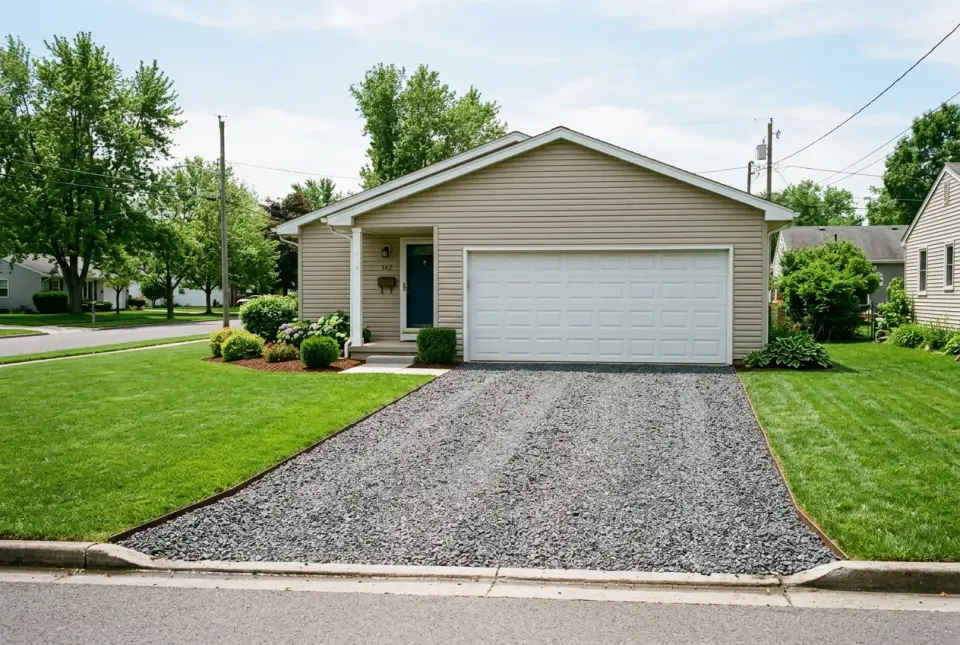
- For a driveway, start with the area and the compacted depth above. New driveways are usually built in layers, a coarse base with a crusher run or #57 surface, so run the calculator once per layer.
- For a shed base, measure the pad you’ll build. It’s normally a little larger than the shed.
- For a French drain, the trench is the “area” and the depth is the trench depth. Don’t subtract anything for the pipe, which is small next to the stone around it. The French drain cost guide covers the rest.
- Under a concrete slab, the American Concrete Institute calls for a 4 in granular base. The concrete calculator handles the slab itself.
- For a paver patio base, use crusher run at 4–6 in deep and order a third extra for compaction.
What gravel costs
Price depends on the type, how far it travels and how much you buy. The gravel cost guide has sourced prices per ton and per yard, delivery fees and a calculator, and the gravel driveway cost guide prices a full driveway.
Questions people ask
How do I calculate how much gravel I need?
Multiply length × width in feet to get square feet, multiply by the depth in inches ÷ 12 to get cubic feet, then divide by 27 for cubic yards. Add about 5% for spillage and uneven ground. For tons, multiply cubic yards by the gravel's weight per yard: #57 stone runs 1.25–1.29 tons per cubic yard.
How much will 1 ton of gravel cover?
One ton of #57 stone is 0.78–0.80 cubic yards, which covers about 126–130 sq ft at 2 inches deep, 84–86 sq ft at 3 inches and 63–65 sq ft at 4 inches. A lighter gravel covers a little more ground per ton and a heavier one a little less, as the table on this page shows.
How much gravel do I need for a 10x10 area?
A 10 × 10 ft area needs 0.62 cubic yards at 2 inches deep and 1.23 cubic yards at 4 inches, before extra for spillage. With 5% extra that is 0.65 or 1.30 cubic yards, so you'd order 1 or 1.5 yards in bulk, or 35 or 70 half-cubic-foot bags.
How much does a 50 lb bag of gravel cover?
Quikrete's 50 lb bag of all-purpose gravel holds 0.5 cubic feet. Spread 2 inches deep it covers 3 sq ft; at 3 inches, 2 sq ft. It takes 54 of these bags to make one cubic yard.
How many wheelbarrows is 1 yard of gravel?
A cubic yard is 27 cubic feet, enough to fill a 6 cu ft contractor wheelbarrow level 4.5 times, so plan on 5 loads. A level-full load of #57 stone weighs about 556–573 lb, which is why many people fill the barrow partway and make more trips.
Is 1 yard of gravel 1 ton?
No. A cubic yard of most crushed stone and gravel weighs more than a ton: #57 stone 1.25–1.29 tons, river rock 1.2–1.3 tons, and pea gravel 1.22–1.5 tons. Lava rock is the exception at about half a ton per yard.
How much gravel do I need for a shed base?
Measure the pad, not the shed. A 10 × 12 ft pad 4 inches deep is 40 cubic feet, or 1.48 cubic yards; with 5% extra, order 2 yards in bulk. Enter your own pad size and depth in the calculator for tons and bags.
Sources
- T.H. Kinsella, Inc. (Kinsella Quarries), Fayetteville, NY, Project Calculator - Materials & Pricing Estimates. Accessed Oct 19, 2026.
- Federal Highway Administration, Strength Characterization of Open-Graded Aggregates for Structural Backfills (FHWA-HRT-15-034), Chapter 3, Table 7. Accessed Oct 19, 2026.
- Graniterock, Southside 1" x #4 Round Rock (Tech Note). Accessed Oct 19, 2026.
- Do it Best (retailer), Quikrete 0.5 Cu. Ft. 50 Lb. All-Purpose Gravel (retailer listing). Accessed Oct 19, 2026.
- Expanded Shale, Clay and Slate Institute (ESCSI), Chapter 4: Proportioning Structural Lightweight Aggregate Concrete, Table 4.8. Accessed Oct 19, 2026.
- Ottr Landscape Supply (Boston, MA), Bulk Landscape Material Weight Guide: Dirt, Gravel, Mulch & More. Accessed Oct 19, 2026.
- Select Sand & Gravel (Texas/Oklahoma), Understanding Material Density: How Much Does a Yard of Landscape Rock Weigh?. Accessed Oct 19, 2026.
- Do it Best (retailer), Pavestone 0.5 Cu. Ft. 45 Lb. Pea Gravel, Model #54255 (retailer listing). Accessed Oct 19, 2026.
- Graniterock, Southside 1 1/2" Round Rock (Tech Note). Accessed Oct 19, 2026.
- Roseville Landscape Material Supply (Roseville, CA), Landscape Materials Calculator - Material Weight and Coverage Reference. Accessed Oct 19, 2026.
- Do it Best (retailer), Pavestone 0.5 Cu. Ft. Decorative Landscape River Pebbles, Model #54250 (retailer listing). Accessed Oct 19, 2026.
- Wisconsin DOT / Wisconsin Highway Research Program (Michigan State Univ. & Univ. of Wisconsin-Madison), Weight-Volume Relationships and Conversion Factors for Soils and Aggregates of Wisconsin (WHRP G22-05 Final Report, Dec 2023). Accessed Oct 19, 2026.
- Penn State Center for Dirt & Gravel Road Studies, Estimating Quantities and Costs (DGLVR Program webinar slides, 2/16/2023). Accessed Oct 19, 2026.
- Select Sand & Gravel (Texas/Oklahoma), What Are Limestone Screenings Used For?. Accessed Oct 19, 2026.
- University of California Agriculture and Natural Resources, Gravel Pathways in the Garden (Earlene Millier, UC Master Gardener; Aug 4, 2011, reissued 2020-03-02). Accessed Oct 19, 2026.
- American Concrete Institute, American Concrete Institute 2022 Draft Group B Proposals for International Code Council model codes (ACI 02, reproducing IRC Section R506). Accessed Oct 19, 2026.
- Belgard (Oldcastle APG), Belgard Technical Resource Guide (BEL25-D-516650), page 6. Accessed Oct 19, 2026.
- Unilock, Do's and Don'ts of Paver Installation: Step 2 of 3 - Base Preparation. Accessed Oct 19, 2026.
- South Dakota LTAP / FHWA (hosted by U.S. EPA), Gravel Roads: Maintenance and Design Manual - Appendix A: Gravel Road Thickness Design Methods (Skorseth & Selim, SD LTAP for FHWA, 2000). Accessed Oct 19, 2026.
- Ram Trucks (Stellantis), 2026 Ram 1500 Specs (Tradesman 4x2 Quad Cab 6'4" box). Accessed Oct 19, 2026.
- The AMES Companies (AMES, Jackson, True Temper, UnionTools brands), Steel Wheelbarrows | Home by AMES. Accessed Oct 19, 2026.
- Penn State Center for Dirt & Gravel Road Studies / PA State Conservation Commission, Driving Surface Aggregate (DSA) Handbook (April 2025). Accessed Oct 19, 2026.