How big is a cord of wood?
A cord of wood is a stack 4 ft high, 4 ft deep and 8 ft long, holding 128 cubic feet of wood, bark and air. NIST Handbook 130, the model regulation states can adopt for selling firewood, defines the cord by volume alone: the amount of wood that fills 128 cubic feet when it is “ranked and well stowed.” Any stack with the same volume is a cord. The National Conference on Weights and Measures’ flyer for firewood buyers gives 2 × 4 × 16 ft as a second example, a long row two feet deep.
-
Full cord
4 × 4 × 8 ft · 128 cu ft
-
Face cord, 16 in wood
4 × 8 ft × 16 in · 42.7 cu ft · 0.33 cord
In metric, a cord is 3.62 cubic meters (128 × 0.3048³). NIST allows firewood to be sold by the cubic meter as well as by the cord.
Minnesota uses a smaller cord for cut firewood. Its statute keeps the 128 cubic foot cord for wood in 4-foot lengths, but a stacked cord of cut firewood is 110 cubic feet for sawed wood and 120 cubic feet for wood that is sawed and split.
How much wood is in a cord?
Less than 128 cubic feet, because round and split pieces never pack solid: part of every cord is air and part is bark. The University of Wisconsin’s extension sheet “What Is a Cord?” breaks an average standard cord into 79 cubic feet of solid wood, 92 cubic feet of wood and bark together, and the rest air: about 62% solid wood, 10% bark and 28% air space.
Other sources put the solid wood at 50–100 cubic feet, and a University of Minnesota extension bulletin ties the spread mainly to the diameter of the pieces. Arkansas Extension puts firewood at about 85 cubic feet of solid wood per cord. Maryland Extension measures 65 to 90 cubic feet, with an average near 80 in that state. Minnesota’s statute uses 79 cubic feet as the basis when a cord is sold by weight. The median across the seven sources we use is 79.
Moisture changes the figure too. Maryland Extension notes that wet wood takes up about 8% more space than the same wood dry, so a cord of green wood packs in less wood than a cord of seasoned wood.
How many pieces of wood are in a cord?
There’s no standard number of pieces in a cord, because that depends on how thick the wood is split. You can count your own: tally the pieces in a 1-foot length of the stack, from the bottom to the top, then multiply by the length of row that makes a cord. With 16-inch wood stacked 4 ft high that’s 24 ft, with 12-inch wood 32 ft, and with 24-inch wood 16 ft.
How to measure a cord of wood
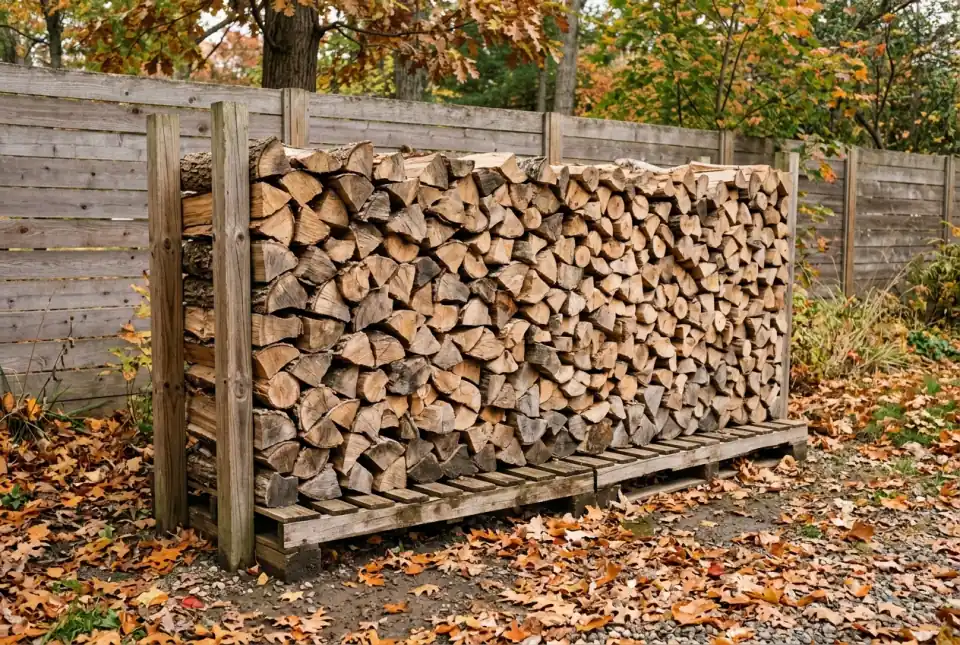
Stack the wood before you measure it. Lay it in rows with the pieces touching and parallel, then measure the length of the row, its height and the length of the pieces, all in feet. Multiply them and divide by 128. Take the height at several points along the row and use the average, and measure a handful of pieces for the piece length.
Worked example, a delivery stacked 12 ft long and 5 ft high, with 16-inch pieces:
| Step | Arithmetic | Result |
|---|---|---|
| Face of the stack | 12 ft × 5 ft | 60 sq ft |
| Volume | 60 sq ft × 1.333 ft (16 in ÷ 12) | 80 cu ft |
| Cords | 80 ÷ 128 | 0.625 cord (five-eighths) |
Sold as a full cord, that load is 48 cubic feet short, or 37.5% of what was paid for. At 5 ft high, a full cord of 16-inch wood is a row about 19 ft 2 in long.
Look for gaps as you measure. Maine’s statute requires deducting any empty space large enough to hold a stick of average size, and that’s a fair standard to use anywhere.
If the wood is still in the truck, Minnesota’s weights and measures office suggests measuring the load itself: the height of the wood × the length × the width of the bed, divided by 160 for sawed wood or 175 for sawed and split wood. Those are Minnesota’s loose-cord sizes; Maine uses 180 cubic feet for 12- or 16-inch wood and 195 for 24-inch. The Truck load tab above does this for common pickup beds.
Settle any shortfall with the seller while the wood is still on the truck if you can. Minnesota’s Weights and Measures says it can’t help with a dispute unless the wood was sold by the cord, the cubic foot or the cubic meter, which is one more reason to buy in those units.
How should you stack a cord of firewood?
Stack it in rows with the pieces touching and parallel. That is how the legal definition of a cord is measured, which NIST’s handbook calls “ranked and well stowed”, and a tight row holds the most wood per foot. For drying, EPA’s advice is to split, stack, cover and store firewood for at least six months if it’s a softwood and at least a year if it’s a hardwood. South Dakota State’s extension service counts wood as seasoned once it has been split, stored off the ground and protected from the weather for at least nine months. So build the rows on pallets or rails, and cover the top. The firewood BTU chart explains what drying does to the heat in a cord.
Full cord vs face cord vs rick
“Full cord” is the 128 cubic foot cord described above, which the University of Wisconsin and Maine’s statute call the standard cord. A face cord is one 4 × 8 ft face of a stack, only as deep as the pieces are long, so its size changes with the piece length: 42.7 cubic feet with 16-inch wood, a third of a cord, and 64 cubic feet with 24-inch wood, half a cord. A rick usually means the same as a face cord, but the word shifts from region to region, and neither term has a legal size. Face cord vs rick vs full cord compares them and shows how to convert a face-cord price.
Half cord and quarter cord
Fractions of a cord are legal units under NIST Handbook 130, which allows firewood to be sold by the cord, by fractional parts of a cord or by the cubic meter. These are the sizes to expect:
| Amount | Cubic feet | Cubic meters | Row 4 ft high of 16-inch wood | Another stack that fits |
|---|---|---|---|---|
| Full cord | 128 | 3.62 | 24 ft long | 4 × 4 × 8 ft |
| Half cord | 64 | 1.81 | 12 ft long | 4 × 4 × 4 ft |
| Quarter cord | 32 | 0.91 | 6 ft long | 4 × 8 ft face of 12-inch pieces |
| Eighth of a cord | 16 | 0.45 | 3 ft long | 4 × 4 ft face of 12-inch pieces |
A half cord of 16-inch wood stacked one row deep and 4 ft high should run 12 ft, the length of one and a half face cords. Below an eighth of a cord, wood is sold as a package: Handbook 130 has bundles under 16 cubic feet labeled by volume in liters, with cubic feet optional.
Will a cord fit in my truck?
Not in one trip in a half-ton pickup. Measured between the wheel wells and stacked level with the rails, a 2026 Ford F-150 with the 6.5 ft bed holds 0.39 cord and the 8 ft bed 0.48 cord. That makes a full cord 2.6 loads in the 6.5 ft bed and 2.1 loads in the 8 ft bed. Thrown in loose, the 6.5 ft bed needs 3.2 to 3.9 loads. To fit a whole cord into that bed, you’d have to stack it about 4.6 ft high, some 34 inches above the rails. A seller who promises a full cord in one pickup load is describing a stack like that.
Weight is the other limit. Wood straight from the tree weighs a lot more than seasoned wood, and dense hardwoods weigh the most.
| Wood | Seasoned, lb per cord | Green, lb per cord |
|---|---|---|
| Osage orange | 4,728 | 5,120 |
| Hickory | 3,952–4,327 | 5,104 |
| White oak | 3,800–4,200 | 5,573 |
| Red oak | 3,528–3,757 | 4,888 |
| Sugar maple | 3,680–3,757 | 4,684 |
| White ash | 3,472–3,689 | 3,952 |
| Paper birch | 2,992–3,179 | 4,312 |
| Douglas-fir | 2,970 | 3,319 |
| Red maple | 2,752–2,924 | 3,904 |
| Ponderosa pine | 2,336 | 3,600 |
| Aspen | 2,160–2,295 | — |
| Eastern white pine | 2,236–2,250 | 2,780 |
| Cottonwood | 2,108–2,272 | 4,640 |
Ranges span the extension sources. Heat is gross heat in air-dried wood, before stove losses. A dash means no sourced figure.
A full cord of seasoned red oak weighs 3,528–3,757 lb. That’s more than the 2,360 lb payload of a 2026 Ram 1500 Tradesman with the 6′4″ box, and more than the 2,440 lb Ford lists as the 2026 F-150’s maximum payload. One 6.5 ft F-150 bed stacked to the rails, 0.39 cord, is 1,363–1,451 lb of seasoned red oak or about 1,888 lb of green red oak. Your own truck’s limit is on the Tire and Loading Information placard on the driver’s door pillar. The Truck load and Weight tabs above run these numbers for your bed and your wood, and how much a cord of wood weighs goes into more detail.
Buying a cord: what the rules say
In states that adopt NIST Handbook 130’s firewood rule, wood must be sold by the cord, by fractions of a cord or by the cubic meter. Connecticut’s consumer protection department publishes the same wording, Wisconsin’s weights and measures fact sheet sets the same three units, and Arkansas Extension notes that Arkansas adopted the uniform standards in 2001. Rules vary from state to state, so your state’s weights and measures office has the final word.
Handbook 130 also requires the seller to hand over a delivery ticket or sales invoice whenever loose, unpackaged firewood is sold. It must show:
- the seller’s and the buyer’s names and addresses, and the date;
- the quantity delivered, and the quantity the price is based on if that differs;
- the price;
- the identity of the wood and any quality claims made for it.
Pennsylvania’s Department of Agriculture gives similar advice to buyers: get a receipt with the seller’s name, address and phone number, the price, the amount and the kind of wood. Ask for the amount as a cord or a fraction of a cord, and for the piece length, before the wood is unloaded. With those in writing you can measure the delivery against them and compare offers on the same footing. For current prices and a quote checker, see how much is a cord of wood, or use the firewood calculator to turn any quote into a price per full cord.