Concrete Calculator
This concrete calculator works out cubic yards and bags for slabs, footings, columns, steps and post holes. A 10 × 10 ft slab 4 in thick needs 1.23 cubic yards (33.3 cubic feet). With 10% extra that's 1.36 yards: 62 bags of 80 lb mix, 82 of 60 lb or 123 of 40 lb.
Example: 10 × 10 ft slab, 4 in thick
1.36 cubic yards
- 62 bags of 80 lb
- 82 bags of 60 lb
- 123 bags of 40 lb
- 36.7 cu ft
33.3 cu ft of concrete + 10% extra
How much concrete do I need?
Concrete is sold by volume, so you need length × width × thickness. Multiply the length and width in feet for square feet, multiply that by the thickness in inches divided by 12 to get cubic feet, then divide by 27 for cubic yards, the unit a ready-mix plant quotes. For the 10 × 10 ft slab in the answer above, that’s 100 sq ft × 4 ÷ 12 = 33.3 cubic feet, and 33.3 ÷ 27 = 1.23 cubic yards.
For a quick check on how many yards of concrete a slab takes, one cubic yard covers 81 sq ft at 4 inches thick and 54 sq ft at 6 inches (324 divided by the thickness in inches).
Then add a margin. The National Ready Mixed Concrete Association advises ordering 4–10 percent more than the plan dimensions give, to cover a low spot in the subgrade, spillage and the like. The calculator adds 10% and lets you change it.
- Area: 12 ft × 12 ft = 144 sq ft; × 4 in deep = 48 cu ft.
- 48 cu ft ÷ 27 = 1.78 cubic yards.
- Adding 10% extra for waste gives 1.96 cubic yards.
- Rounded up to the next 0.5 cubic yard: order 2 cubic yards.
- Weight of concrete: 3.7–4.09 tons, once cured.
In bags, the same 52.8 cubic feet (48 plus 10%) is 88 bags of 80 lb mix (52.8 ÷ 0.60) or 118 of 60 lb. A ready-mix order is rounded up to the next half yard instead.
Concrete slab calculator: how many bags of concrete do I need?
These are the slab tab’s results for the sizes people ask about most, from a 4 × 4 ft pad to a 30 × 40 ft shop floor. Each row includes the 10% extra; the small figure under the cubic yards is the volume before it.
| Slab | Cubic yards | 80 lb bags | 60 lb bags | 40 lb bags |
|---|---|---|---|---|
| 4 × 4 ft, 16 sq ft | 0.22, 0.2 before extra | 10 | 14 | 20 |
| 8 × 8 ft, 64 sq ft | 0.87, 0.79 before extra | 40 | 53 | 79 |
| 10 × 10 ft, 100 sq ft | 1.36, 1.23 before extra | 62 | 82 | 123 |
| 10 × 12 ft, 120 sq ft | 1.63, 1.48 before extra | 74 | 98 | 147 |
| 12 × 12 ft, 144 sq ft | 1.96, 1.78 before extra | 88 | 118 | 176 |
| 12 × 16 ft, 192 sq ft | 2.61, 2.37 before extra | 118 | 157 | 235 |
| 16 × 20 ft, 320 sq ft | 4.35, 3.95 before extra | 196 | 261 | 392 |
| 20 × 20 ft, 400 sq ft | 5.43, 4.94 before extra | 245 | 326 | 489 |
| 24 × 24 ft, 576 sq ft | 7.82, 7.11 before extra | 352 | 470 | 704 |
| 30 × 40 ft, 1,200 sq ft | 16.3, 14.81 before extra | 734 | 978 | 1,467 |
4 in thick, with 10% extra, as the calculator does. Bag yields are the manufacturer's: 0.60, 0.45 and 0.30 cu ft.
| Slab | Cubic yards | 80 lb bags | 60 lb bags | 40 lb bags |
|---|---|---|---|---|
| 8 × 8 ft, 64 sq ft | 1.3, 1.19 before extra | 59 | 79 | 118 |
| 10 × 10 ft, 100 sq ft | 2.04, 1.85 before extra | 92 | 123 | 184 |
| 12 × 12 ft, 144 sq ft | 2.93, 2.67 before extra | 132 | 176 | 264 |
| 16 × 20 ft, 320 sq ft | 6.52, 5.93 before extra | 294 | 392 | 587 |
| 20 × 20 ft, 400 sq ft | 8.15, 7.41 before extra | 367 | 489 | 734 |
| 24 × 24 ft, 576 sq ft | 11.73, 10.67 before extra | 528 | 704 | 1,056 |
| 30 × 40 ft, 1,200 sq ft | 24.44, 22.22 before extra | 1,100 | 1,467 | 2,200 |
6 in thick, with 10% extra, as the calculator does. Bag yields are the manufacturer's: 0.60, 0.45 and 0.30 cu ft.
A 20 × 20 ft slab at 4 inches already takes 245 bags of 80 lb mix. That’s 19,600 lb to lift into a mixer one bag at a time, and well past the point where a truck is cheaper (see the break-even below).
How many bags of concrete are in a yard?
Divide 27 cubic feet by what one bag makes. Quikrete’s data sheet gives 0.6 cu ft for an 80 lb bag of its concrete mix, 0.45 cu ft for 60 lb and 0.3 cu ft for 40 lb. Sakrete lists the same three yields for its high-strength mix, so the counts hold for either brand.
| Bag size | Yield per bag | Bags per cubic yard | With 10% extra |
|---|---|---|---|
| 80 lb | 0.60 cu ft | 45 | 50 |
| 60 lb | 0.45 cu ft | 60 | 66 |
| 40 lb | 0.30 cu ft | 90 | 99 |
| 50 lb fast-setting | 0.375 cu ft | 72 | 80 |
Bag size doesn’t change the total weight. Every size works out to 133 lb of dry mix per cubic foot of concrete, so a cubic yard is 3,600 lb of bags (45 × 80 lb) whichever size you buy. With smaller bags you carry more of them.
How much does a bag of concrete cover?
Coverage is the bag’s yield divided by the slab thickness in feet. At 4 inches (a third of a foot), an 80 lb bag covers 0.60 ÷ 0.333 = 1.8 sq ft.
| Bag size | 4 in thick | 5 in thick | 6 in thick |
|---|---|---|---|
| 80 lb | 1.8 sq ft | 1.44 sq ft | 1.2 sq ft |
| 60 lb | 1.35 sq ft | 1.08 sq ft | 0.9 sq ft |
| 40 lb | 0.9 sq ft | 0.72 sq ft | 0.6 sq ft |
These figures are before any extra. Put the other way, a 4-inch slab takes 0.56 bags of 80 lb mix per square foot, which is why a 10 × 10 ft slab needs 56 bags before the margin and 62 after it.
Concrete calculator for footings, columns and steps
Every tab uses the same 10% extra and bag yields, and shows the order in cubic yards and in bags.
Footings
A footing is a long, narrow box: length × width × depth, with the width and depth usually in inches. Your plans or building department set its size and how deep it goes for your local frost depth. Call 811 before you dig so buried lines are marked.
- 40 ft × (16 ÷ 12) ft × (8 ÷ 12) ft = 35.56 cu ft.
- 35.56 cu ft ÷ 27 = 1.32 cubic yards.
- Adding 10% gives 39.11 cu ft (1.45 cubic yards): 66 bags of 80 lb mix, or a 1.5-yard ready-mix order.
A concrete block wall sits on a footing like this one; the concrete block calculator counts the blocks, mortar and core fill for the wall above it.
Columns and Sonotubes
A round column is π × radius² × height. The diameter chips in the Column tab are Sonoco’s Builder’s Tube sizes, 6, 8, 10 and 12 inches. Measure the full height of concrete in the tube, including the part below ground, and enter how many tubes you’re filling.
- π × (5 ÷ 12)² × 4 ft = 2.18 cu ft, or 0.08 cubic yards.
- Adding 10% gives 2.40 cu ft: 4 bags of 80 lb mix or 6 bags of 60 lb.
Sonoco’s chart agrees: it lists 0.55 cu ft per foot of height for a 10-inch tube, or 2.2 cu ft for 4 ft. The fence post concrete calculator has bag counts for each tube size.
Steps
The calculator treats each step as solid concrete from the ground up: the bottom step is one rise tall, the next is two rises, and so on. That gives width × run × rise × (1 + 2 + … + the number of steps).
- 1 + 2 + 3 + 4 = 10 step blocks.
- 4 ft × (11 ÷ 12) ft × (7 ÷ 12) ft × 10 = 21.39 cu ft.
- 21.39 cu ft ÷ 27 = 0.79 cubic yards.
- Adding 10% gives 23.53 cu ft (0.87 cubic yards): 40 bags of 80 lb mix.
If the steps end at a landing, add it as a separate slab whose thickness is the full height of the stairs (4 × 7 in = 28 in here). Steps built over compacted fill or against a slope take less.
Post holes
The Post holes tab subtracts each post and the gravel in the bottom of the hole; its 12-post example takes 21 bags of 80 lb mix. The fence post concrete calculator covers hole sizes and fast-setting bags.
How thick should a concrete slab be?
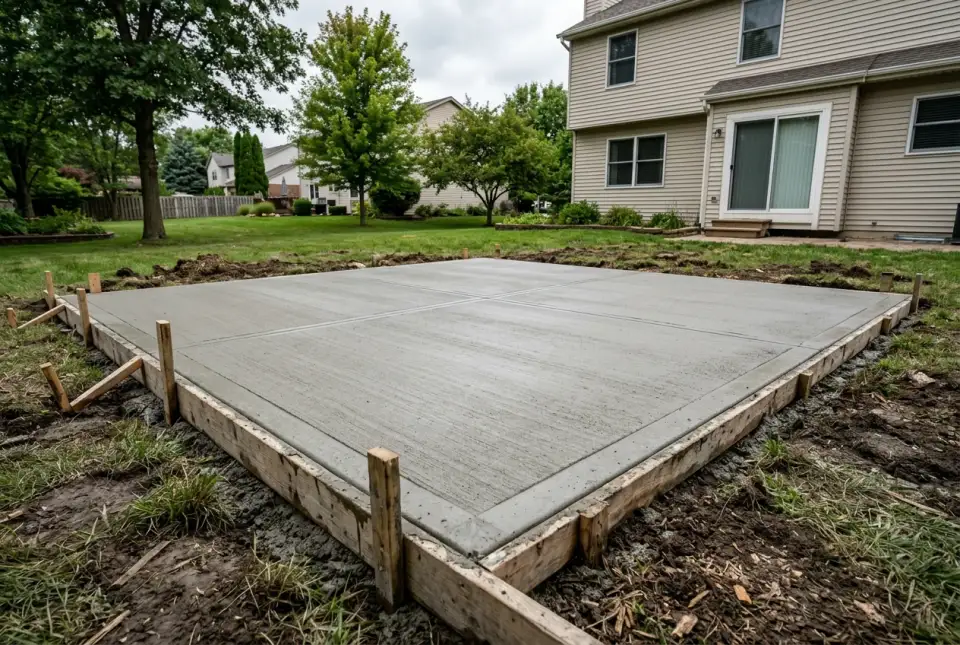
Most of the sources below set four inches as the minimum for patios, walks and driveways that carry cars. Heavier traffic raises it, and the building code lets a house floor slab be a little thinner:
-
House floor (IRC minimum)
3.5 in
-
Patio or walk
4 in
-
Driveway, cars
4 in
-
Driveway, delivery trucks
5 in
-
Driveway apron at the street
6 in
- Sakrete’s instructions for slabs, sidewalks and walkways call for at least 4 inches of concrete.
- The Michigan Concrete Association sets 4 inches as the minimum for a driveway and 5 inches when delivery vehicles use it. County Materials’ driveway FAQ agrees, with 5 inches or more for garbage trucks and other heavy vehicles.
- The International Residential Code’s minimum for a house floor slab is 3.5 inches. The Ohio ready-mix association uses 3.5 inches for driveways, patios and walks where no code sets a thickness, and notes that codes usually ask for 6 inches for the apron between the street and the sidewalk.
- Cities can set their own rules. Des Plaines, Illinois, for example, requires a garage slab at least 4 inches thick on at least 6 inches of CA-6 gravel.
Every inch you add to a 4-inch slab adds a quarter of its volume. Going from 4 to 5 inches takes the 12 × 12 ft patio from 1.78 to 2.22 cubic yards before extra.
Thickness also sets the joint layout. The Michigan Concrete Association’s guideline for driveways and sidewalks places control joints in both directions, no farther apart in feet than twice the slab thickness in inches: 8 ft for a 4-inch slab and 10 ft for 5 inches. By that rule, a 12 ft wide driveway at 4 inches needs at least one joint running its length, such as one down the middle, plus cross joints every 8 ft or less.
Bags or ready-mix? Where the break-even falls
These are national typical prices from our October 2026 survey of retailers, ready-mix suppliers and cost guides. Prices vary by region, so use your own quotes where you have them.
80 lb bags cost $6.24–$6.47, which is $281–$291 per cubic yard of concrete at 45 bags a yard. 60 lb bags at $4.85 (one retailer) come to $291 a yard; the one 40 lb price we found, $6.59, is $593 a yard.
Ready-mix costs $130–$162 per cubic yard. On an order smaller than a full truck, which carries 9–11 cubic yards according to the National Ready Mixed Concrete Association, suppliers add a short-load fee of $42–$55 per yard. Price lists also add a flat delivery or environmental fee of $60–$95 per truck.
That puts a small ready-mix order at $172–$217 a yard plus the flat fee. Across these ranges the break-even falls between about half a yard and 1.5 cubic yards. Below that, bags are usually cheaper, and above it the truck usually wins.
The 10 × 10 ft slab falls inside that band. With the 10% extra it needs 1.36 yards: 62 bags of 80 lb mix for $385–$400, or a 1.5-yard ready-mix order with the short-load and delivery fees for $320–$420. At that size the truck saves you mixing 62 bags by hand, but it arrives with the whole load at once, so the forms, base and helpers have to be ready. Ask about minimum orders when you call. The cost of concrete per yard guide covers these fees in more detail.
Gravel base and reinforcement
Concrete goes on a compacted base. The International Residential Code calls for a 4 inch base of clean graded sand, gravel or crushed stone under house floor slabs. For driveways, the Michigan Concrete Association’s minimum is 4 inches of compacted sub-base, and County Materials recommends 6–12 inches of compacted gravel or crushed stone.
-
Under a house floor slab (IRC)
4 in
-
Driveway minimum (Michigan)
4 in
-
Driveway, recommended (County Materials)
6–12 in
The base covers the same area as the slab, so a 4-inch base under the 12 × 12 ft patio is another 1.78 cubic yards before extra. #57 stone weighs 1.25–1.29 tons per cubic yard, and the gravel calculator turns your base depth into tons and bags.
Rebar sizes and spacing come from your plans or building department; the calculator doesn’t size reinforcement. Gerdau lists #3 bar at 0.38 lb per foot, #4 at 0.67 lb per foot and #5 at 1.04 lb per foot. Bar comes in stock lengths of 20 ft and longer, and a 20 ft stick of #4 weighs 13.4 lb.
Where two bars overlap, the International Residential Code’s lap splice table, Table R608.5.4(1), lists 20 inches for #4 Grade 40 bar and 30 inches for #4 Grade 60, and 25 and 38 inches for #5. The table sits in the IRC’s wall chapter, so treat it as guidance only. The Concrete Reinforcing Steel Institute notes that lap length depends on concrete strength, bar grade, bar size and spacing. Follow your plans or your building department.
Will the bags fit in a pickup?
Usually not in one trip. The 62 bags for a 10 × 10 ft slab weigh 4,960 lb, more than twice the 2,360 lb payload of the 2026 Ram 1500 Tradesman the calculator uses as its example truck, so that’s 3 trips. For your own truck, enter the payload from the sticker on the driver’s door jamb.
The finished slab is heavy too. Cured concrete weighs 3,780–4,185 lb per cubic yard, so the 10 × 10 ft slab weighs 2.3–2.6 tons once it’s poured.
What concrete costs
The cost to pour a concrete slab guide prices a whole slab per square foot, with labor, and compares pouring it yourself with hiring a contractor. For the concrete alone, see the cost of concrete per yard. The concrete patio cost and concrete driveway cost guides cover finishes, base preparation and tear-out for those two jobs.
Questions people ask
How many bags of concrete do I need for a 10x10 slab?
At 4 inches thick, a 10 × 10 ft slab is 33.3 cubic feet (1.23 cubic yards). With 10% extra that's 36.7 cubic feet: 62 bags of 80 lb mix, 82 bags of 60 lb or 123 bags of 40 lb. At 6 inches thick it takes 92 bags of 80 lb or 123 of 60 lb.
How many 80 lb bags of concrete are in a yard?
45. An 80 lb bag yields 0.60 cubic feet of concrete, and a cubic yard is 27 cubic feet, so 27 ÷ 0.60 = 45 bags. With 10% extra for waste, buy 50 bags per cubic yard.
How many 60 lb bags of concrete are in a yard?
60. A 60 lb bag yields 0.45 cubic feet, and 27 ÷ 0.45 = 60. With 10% extra, buy 66 bags per cubic yard. For 40 lb bags (0.30 cubic feet each) the figures are 90 and 99.
How much does a bag of concrete cover?
At 4 inches thick, an 80 lb bag covers 1.8 sq ft, a 60 lb bag 1.35 sq ft and a 40 lb bag 0.9 sq ft. At 6 inches thick the same bags cover 1.2, 0.9 and 0.6 sq ft. Divide the bag's yield in cubic feet by the thickness in feet to get these.
How do I calculate cubic yards of concrete?
Multiply length × width in feet, multiply by the thickness in inches ÷ 12, then divide by 27. A 12 × 12 ft patio 4 inches thick is 144 × 4 ÷ 12 = 48 cubic feet, and 48 ÷ 27 = 1.78 cubic yards before extra.
How much extra concrete should I order?
The National Ready Mixed Concrete Association advises ordering 4–10% more than the plan dimensions give. The calculator adds 10%, the top of that range, and you can change it.
Is it cheaper to use bags or ready-mix?
On national typical prices, 80 lb bags cost about $281–$291 per cubic yard of concrete. Ready-mix costs $130–$162 a yard plus short-load and delivery fees on a small order. Across those ranges, ready-mix becomes the cheaper choice somewhere between 0.5 and 1.5 cubic yards. Prices vary by region.
How thick should a concrete patio be?
Sakrete's instructions for slabs, sidewalks and walkways call for at least 4 inches of concrete, and 4 inches is the usual patio thickness. Driveways start at 4 inches for cars and go to 5 inches or more where delivery trucks or other heavy vehicles drive. Check your local code before you pour.
Sources
- Federal Highway Administration, U.S. Department of Transportation, Appendix C: Proposed Revisions to the AASHTO Standard Specifications for Highway Bridges (FHWA-HRT-05-057). Accessed Oct 19, 2026.
- The Quikrete Companies, LLC, QUIKRETE Concrete Mix (No. 1101) Data Sheet, revised October 2022. Accessed Oct 19, 2026.
- National Ready Mixed Concrete Association (NRMCA), CIP 36 - Structural Lightweight Concrete. Accessed Oct 19, 2026.
- FEMA National US&R Response System, US&R Structural Collapse Technician, Module 1C Part 3 - Hazard Identification & Building Monitoring. Accessed Oct 19, 2026.
- U.S. Navy (Naval Education and Training), Builder Advanced (NAVEDTRA 14045A), Chapter 3 Concrete Construction, 5.3.1. Accessed Oct 19, 2026.
- The Quikrete Companies, LLC, QUIKRETE Fast-Setting Concrete Mix (No. 1004) Data Sheet, revised November 2025. Accessed Oct 19, 2026.
- Sonoco, Sonotube Builder's Tube concrete forms brochure ((c)2016). Accessed Oct 19, 2026.
- The Quikrete Companies, LLC, Setting Posts in Concrete. Accessed Oct 19, 2026.
- SAKRETE of North America LLC, Sakrete Fast Setting Concrete Mix Technical Data Sheet (Rev. 05/18). Accessed Oct 19, 2026.
- SAKRETE of North America LLC, Sakrete High-Strength Concrete Mix Technical Data Sheet ((c)2023). Accessed Oct 19, 2026.
- County Materials Corp. (content refers readers to the Wisconsin Ready Mixed Concrete Association, wrmca.com), Frequently Asked Questions (FAQ's) about Concrete Driveways. Accessed Oct 19, 2026.
- Ram Trucks (Stellantis), 2026 Ram 1500 Specs (Tradesman 4x2 Quad Cab 6'4" box). Accessed Oct 19, 2026.
- National Ready Mixed Concrete Association (NRMCA), CIP 31 – Ordering Ready Mixed Concrete. Accessed Oct 19, 2026.
- Sakrete (SAKRETE of North America LLC / Oldcastle APG), High-Strength Concrete Mix (product page). Accessed Oct 19, 2026.
- American Concrete Institute, American Concrete Institute 2022 Draft Group B Proposals for International Code Council model codes (ACI 02, reproducing IRC Section R506). Accessed Oct 19, 2026.
- City of Des Plaines, IL, Community and Economic Development, Residential Detached Garages (permit handout, 2025). Accessed Oct 19, 2026.
- Michigan Concrete Association (MI-Concrete), Driveway & Sidewalk Design and Placement Guidelines. Accessed Oct 19, 2026.
- Ohio Concrete (Ohio Ready Mixed Concrete Association), Industry Recommendation for Exterior Concrete Flatwork. Accessed Oct 19, 2026.
- National Ready Mixed Concrete Association (NRMCA), About Concrete. Accessed Oct 19, 2026.
- Gerdau, Straight Rebar. Accessed Oct 19, 2026.
- International Code Council (codes.iccsafe.org), 2021 International Residential Code, Chapter 6, Table R608.5.4(1) Lap Splice and Tension Development Lengths. Accessed Oct 19, 2026.
- T.H. Kinsella, Inc. (Kinsella Quarries), Fayetteville, NY, Project Calculator - Materials & Pricing Estimates. Accessed Oct 19, 2026.
- Federal Highway Administration, Strength Characterization of Open-Graded Aggregates for Structural Backfills (FHWA-HRT-15-034), Chapter 3, Table 7. Accessed Oct 19, 2026.
- Graniterock, Southside 1" x #4 Round Rock (Tech Note). Accessed Oct 19, 2026.
- Do it Best (retailer), Quikrete 0.5 Cu. Ft. 50 Lb. All-Purpose Gravel (retailer listing). Accessed Oct 19, 2026.
- ConcreteNetwork.com, Concrete Prices 2026 - How Much is a Yard of Concrete?. Accessed Oct 19, 2026.
- LawnStarter, How Much Does Concrete Cost Per Yard in 2026?. Accessed Oct 19, 2026.
- HomeGuide, How Much Does Concrete Cost Per Yard? (2026). Accessed Oct 19, 2026.
- National Ready Mixed Concrete Association (NRMCA), Annual Performance Benchmarking Survey (2023 data). Accessed Oct 19, 2026.
- Gehring Construction & Ready-Mix, Ready-Mix Products & Pricing (prices effective January 1st, 2026). Accessed Oct 19, 2026.
- Townsend Concrete, Mixed On Site Ready Mix Concrete Price List (Vacaville, Solano/Yolo County CA). Accessed Oct 19, 2026.
- Supreme Concrete, Price list - Supreme Concrete Ready Mix Concrete. Accessed Oct 19, 2026.
- Short Load Concrete LLC, PRICE LIST. Accessed Oct 19, 2026.
- Concrete Mix USA, Concrete Prices Per Cubic Yard in Orlando, FL (2026 Price List). Accessed Oct 19, 2026.
- Quick Mix Concrete, Concrete Mixes and Strengths | Quick Mix Concrete Pricing. Accessed Oct 19, 2026.
- Bucks Ready Mix, How Much Does a Load of Ready-Mix Concrete Cost?. Accessed Oct 19, 2026.
- Angi, Concrete Cost Per Yard [2026 Data]. Accessed Oct 19, 2026.
- The Home Depot, Concrete - The Home Depot. Accessed Oct 19, 2026.
- Lowe's, Sakrete 80-lb High strength Concrete mix. Accessed Oct 19, 2026.
- Lowe's, QUIKRETE 80-lb High strength Concrete mix. Accessed Oct 19, 2026.
- Lowe's, Sakrete 60-lb High strength Concrete mix. Accessed Oct 19, 2026.
- Lowe's, QUIKRETE 60-lb High strength Concrete mix. Accessed Oct 19, 2026.
- Ace Hardware, Quikrete Concrete Mix 40 lb Gray Mfr# 1101-40. Accessed Oct 19, 2026.
- Concrete Reinforcing Steel Institute (CRSI), Lap Splices. Accessed Oct 19, 2026.