Concrete Block Calculator
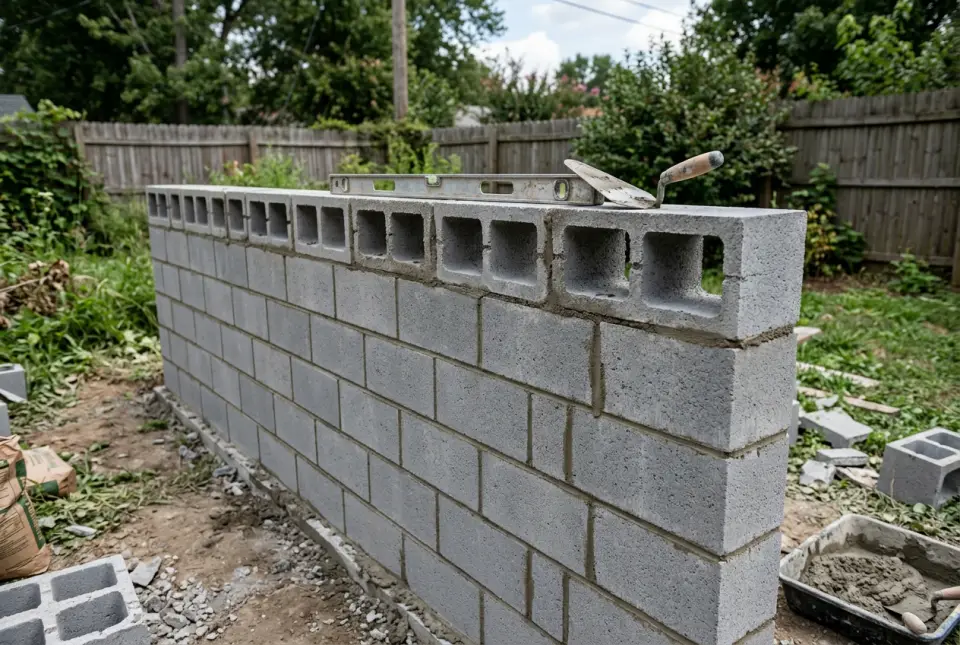
This concrete block calculator counts 8 × 8 × 16 in blocks, mortar and core fill for a wall. Standard blocks take 1.125 per square foot, so a wall 40 ft long and 4 ft high (160 sq ft) needs 180 blocks, or 189 with 5% extra for cuts and breakage, plus 12–15 bags of 80 lb mortar.
Example: wall 40 ft long, 4 ft high
189 blocks
- 12–15 bags of mortar (80 lb)
160 sq ft of wall · 6 courses × 30 blocks · 180 + 5% for cuts
How to calculate how many concrete blocks you need
Start with the face of the wall. Multiply its length by its height in feet for square feet, subtract any doors or windows, and multiply by 1.125, the number of standard blocks in one square foot of wall. Then add 5% for cut blocks and breakage, the same allowance the Concrete Masonry & Hardscapes Association (CMHA, formerly NCMA) uses: 119 blocks per 100 sq ft, including 5% waste.
The 1.125 comes from the size each block takes up once it’s laid. With its mortar joint, a standard block covers 8 × 16 in, or 128 square inches, and a square foot is 144 square inches: 144 ÷ 128 = 1.125.
You can check the count course by course. Divide the wall height by 8 inches for the number of courses, and the length by 16 inches for the blocks in each course.
- Wall face: 40 ft × 4 ft = 160 sq ft.
- Blocks: 160 × 1.125 = 180. As a check, 48 in ÷ 8 in = 6 courses, and 480 in ÷ 16 in = 30 blocks per course; 6 × 30 = 180.
- Adding 5% for cuts and breakage: 180 × 1.05 = 189 blocks.
- Mortar: 180 blocks need 11.25–14.99 bags of 80 lb mix at 6.25–8.33 bags per 100 blocks, so buy 12–15 bags.
- Filling every core: 180 × 0.321 cu ft = 57.8 cu ft (2.14 cubic yards), or 97 bags of 80 lb concrete mix.
The calculator does the same sums, and the line under its result shows the square feet, the courses and the blocks per course so you can check them against your plans.
Block sizes: nominal vs actual
The 8 × 8 × 16 in name is the nominal size. Angelus Block lists the actual size of that block as 7⅝ × 7⅝ × 15⅝ inches; the missing 3/8 inch on each dimension is the mortar joint. When you measure an existing wall, a block plus one joint is 8 in high and 16 in long, which is why the counts on this page use those figures.
The count per square foot depends only on the size of the block’s face. A 6 in or 12 in wide block with the same 8 × 16 in face takes the same 1.125 blocks per square foot, while a block with a different face size needs its own count. Width changes the core fill instead: the wider the block, the more grout or concrete each one holds, as the section on filling cores shows.
Blocks for common wall sizes
These are the calculator’s results for walls people often build, from a short planter wall to a 100 ft run. Each row includes the 5% extra, with the count before it underneath.
| Wall | Blocks (+5%) | Mortar, 80 lb bags | Grout to fill every core |
|---|---|---|---|
| 10 ft long × 4 ft high, 40 sq ft | 48, 45 before extra | 3–4 | 14.4 cu ft |
| 20 ft long × 4 ft high, 80 sq ft | 95, 90 before extra | 6–8 | 28.9 cu ft |
| 30 ft long × 3 ft high, 90 sq ft | 108, 102 before extra | 7–9 | 32.7 cu ft |
| 40 ft long × 4 ft high, 160 sq ft | 189, 180 before extra | 12–15 | 57.8 cu ft |
| 40 ft long × 8 ft high, 320 sq ft | 378, 360 before extra | 23–30 | 115.6 cu ft |
| 50 ft long × 6 ft high, 300 sq ft | 355, 338 before extra | 22–29 | 108.5 cu ft |
| 100 ft long × 4 ft high, 400 sq ft | 473, 450 before extra | 29–38 | 144.5 cu ft |
Standard 8 × 8 × 16 in block. Mortar spans the manufacturers' figures per 100 blocks; grout is for fully grouted walls.
A wall 3 ft high is 4.5 courses tall, so its top course is cut blocks. The calculator shows 5 courses, rounded up, but its block total comes from the wall area, so the half course is counted as half.
Openings, corners and half blocks
Add each door or window with the “Add a door or window” button, and the calculator takes its area out of the wall before counting. A 40 ft wall 8 ft high is 320 sq ft. Take out a 3 × 7 ft door and it’s 299 sq ft: 337 blocks, 354 with the 5% extra, and 22–29 bags of mortar.
The count is by area, so it doesn’t separate corner, end or half blocks from full ones. If your supplier sells half-length units for the ends of courses, two of them fill the space of one full block, so swap them in for full blocks and leave the total as it is. The 5% extra covers the blocks you cut to fit around openings and at the ends of courses.
How much mortar per 100 blocks
The manufacturers and the trade association give slightly different figures, so the calculator shows a range in 80 lb bags of mortar mix:
- Quikrete says one 80 lb bag of its mortar mix lays up to 13 standard blocks, which is 7.69 bags per 100 blocks.
- Sakrete says its Type S mortar mix lays 12 standard 8 in blocks per 80 lb bag, or 8.33 bags per 100.
- CMHA’s estimating guide lists 16 blocks per 80 lb bag of preblended mortar, or 6.25 bags per 100.
For 100 blocks, buy 7 to 9 bags. The calculator applies the range to the blocks before the 5% extra, since the spare blocks don’t all get laid.
If you’d rather mix your own mortar from masonry cement and sand, CMHA says one 70 lb bag of masonry cement lays about 30 hollow blocks, and it takes about a ton of sand for every 8 bags. For 100 blocks that’s 3.33 bags of masonry cement (buy 4) and about 0.42 ton of sand.
Filling block cores with concrete or grout
Check “Fill every core” and the calculator adds the volume to fill all the cells, using CMHA’s figure for an 8 in wall: 36.1 cubic feet per 100 sq ft, or 0.32 cubic feet per block. That figure already includes 3% waste. The result comes in cubic feet and in bags of 80 lb concrete mix. Your wall’s plans say whether to fill the cores with concrete or with masonry grout.
Wider walls take more. CMHA’s table gives 25.6 cubic feet per 100 sq ft for a fully grouted 6 in wall and 47.0 for a 10 in wall.
If your plans grout only some cells, for example the ones that hold vertical rebar, the volume drops. For an 8 in wall, CMHA lists these volumes per 100 sq ft by the spacing of the grouted cells:
| Grouted cells every | Grout per 100 sq ft | For the 40 × 4 ft wall | 80 lb bags |
|---|---|---|---|
| 8 in (every cell) | 36.1 cu ft | 57.8 cu ft | 97 |
| 16 in | 18.1 cu ft | 29.0 cu ft | 49 |
| 24 in | 12.1 cu ft | 19.4 cu ft | 33 |
| 32 in | 9.1 cu ft | 14.6 cu ft | 25 |
| 48 in | 6.1 cu ft | 9.8 cu ft | 17 |
The spacing comes from your plans. The table covers the vertical cells only; a bond beam along the top course is extra.
The footing under a block wall
A block wall sits on a concrete footing, and the plans or your building department set its width and depth. The bottom of the footing has to be below your area’s frost depth, which the building department can give you. Call 811 before you dig so buried lines are marked.
Once you have the size, the Footing tab of the concrete calculator turns it into cubic yards and bags. A footing 40 ft long, 16 in wide and 8 in deep, for example, is 35.56 cubic feet, or 1.32 cubic yards before the extra.
Block wall cost
The retaining wall cost guide has installed prices per square foot of wall face. Height also decides whether you need an engineer. Under the International Residential Code, a retaining wall that holds back more than 48 inches of unbalanced fill needs an engineered design, and so does one over 24 inches tall that resists loads in addition to the soil. You may also need a permit, so check with your building department before you order blocks.
Questions people ask
How do I calculate how many concrete blocks I need?
Multiply the wall's length by its height in feet for square feet, subtract any doors or windows, then multiply by 1.125 for standard 8 × 16 in face blocks. Add 5% for cuts and breakage. A 40 × 4 ft wall is 160 sq ft × 1.125 = 180 blocks, or 189 with the extra.
How many blocks are in a square foot?
1.125 standard blocks. Each block plus its mortar joint covers 8 × 16 in, or 128 square inches, and a square foot is 144 square inches: 144 ÷ 128 = 1.125. That's 112.5 blocks per 100 sq ft, or 119 with the 5% waste allowance the Concrete Masonry & Hardscapes Association uses.
How many cement blocks do I need for 1,000 square feet?
1,125 standard 8 × 8 × 16 in blocks for 1,000 sq ft of wall, or 1,182 with 5% extra. The Concrete Masonry & Hardscapes Association's rounded rate of 119 blocks per 100 sq ft gives 1,190. Subtract door and window openings first.
How many bags of mortar for 100 blocks?
6.25–8.33 bags of 80 lb mortar mix, so buy 7–9 bags. Quikrete says one 80 lb bag lays up to 13 standard blocks, Sakrete says 12, and the Concrete Masonry & Hardscapes Association uses 16.
How much sand and cement do I need for 100 blocks?
If you mix your own mortar, the Concrete Masonry & Hardscapes Association says one 70 lb bag of masonry cement lays about 30 hollow blocks, with about a ton of sand for every 8 bags. For 100 blocks that's 3.33 bags (buy 4) and about 0.42 ton, or 833 lb, of sand.
What size is an 8x8x16 block really?
7⅝ × 7⅝ × 15⅝ inches (7.625 × 7.625 × 15.625). The 8 × 8 × 16 name is the nominal size, which includes one 3/8-inch mortar joint. Laid in a wall, each block takes up a full 8 × 16 in of face.
How much concrete does it take to fill concrete block cores?
About 0.32 cubic feet per standard 8 in block if every core is filled, or 36.1 cubic feet per 100 sq ft of wall, which is 1.34 cubic yards. Those figures come from the Concrete Masonry & Hardscapes Association and include 3% waste. A 40 × 4 ft wall takes 57.8 cubic feet, or 97 bags of 80 lb concrete mix.
Sources
- Concrete Masonry & Hardscapes Association (CMHA, formerly NCMA), TEK 04-02A Estimating Concrete Masonry Materials. Accessed Oct 19, 2026.
- Concrete Masonry & Hardscapes Association (CMHA, formerly NCMA), TEK 04-02A Estimating Concrete Masonry Materials (PDF), Table 3. Accessed Oct 19, 2026.
- The Quikrete Companies, LLC, QUIKRETE Mortar Mix (No. 1102) Data Sheet, revised November 2020. Accessed Oct 19, 2026.
- Sakrete, Mortar Mix – Type S (product page). Accessed Oct 19, 2026.
- The Quikrete Companies, LLC, QUIKRETE Concrete Mix (No. 1101) Data Sheet, revised October 2022. Accessed Oct 19, 2026.
- Angelus Block Co., Inc., Dimensions and Sizes. Accessed Oct 19, 2026.
- International Code Council (codes.iccsafe.org), 2021 International Residential Code, Chapter 4 Foundations, Section R404.4 Retaining walls. Accessed Oct 19, 2026.