How much does a gravel driveway cost to install?
Gravel driveways are the one price in our survey where national cost guides clearly disagree. LawnStarter gives an average of $1–$3 per square foot installed. Angi gives $1–$10, depending on the gravel, the size of the driveway and how much site prep it needs. Our typical range, $1–$4.75, is the middle of those figures; the full span runs from $1 to $10. Any single per-square-foot number is only a rough guide.
The gap comes from what each figure includes. On the 60 × 10 ft driveway in the calculator, 4.5 inches of #57 stone delivered costs $315–$755, which is $0.55–$1.25 per square foot for the stone alone. A $1 per square foot price covers little more than the stone on a bed that’s already graded. The top of Angi’s range pays for digging out soil, grading, fabric, a base layer, compaction and machine time. So the most useful way to check a gravel driveway price is from its parts: tons of stone, delivery, and the hours of work and equipment.
Cost per foot of driveway, 50 ft to a quarter mile
For long rural driveways, people think in feet of length. At 10 ft wide the typical range is $10–$48 per foot; at 12 ft wide it’s $12–$57.
| Size | Installed |
|---|---|
| 50 × 10 ft · 500 sq ft | $500–$2,380 |
| 100 × 10 ft · 1,000 sq ft | $1,000–$4,750 |
| 100 × 12 ft · 1,200 sq ft | $1,200–$5,700 |
| 200 × 12 ft · 2,400 sq ft | $2,400–$11,400 |
| Quarter mile (1,320 × 12 ft) · 15,840 sq ft | $15,840–$75,240 |
National typical range, 2026 sources, which disagree widely; individual figures run from $1 to $10 per sq ft. Installed: $1–$4.75 per sq ft.
A $60,000 quote can be reasonable for a long driveway. At 12 ft wide and $1–$4.75 per square foot, $60,000 is a typical price for a driveway roughly 1,050 to 5,000 feet long. A quarter mile at that price works out to $3.79 a square foot, inside the typical range. On a shorter driveway, $60,000 points to heavy grading, clearing, culverts or drainage work, and the quote should say so line by line.
The layers and what each costs
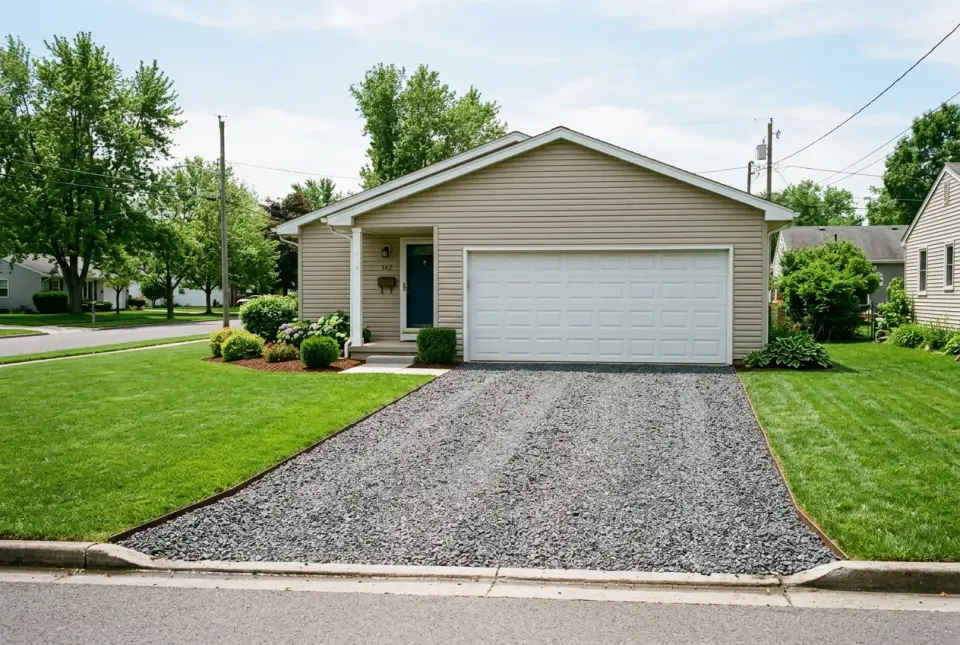
A gravel driveway is built in layers: the soil underneath, sometimes a fabric to keep it separate from the stone, often a base of coarse stone where the soil is soft, and a surface of crushed stone with fines that packs hard. Clean stone such as #57 drains well and suits the bottom; crusher run, crushed stone mixed with its own dust, packs into a firm top.
Only the surface layer has sourced depths. South Dakota’s gravel roads manual, written for the Federal Highway Administration, suggests 4.5–6.5 inches of compacted surface gravel for light truck traffic: 4.5 inches on firm soil and 6.5 inches on weak soil. In its handbook on driving surface aggregate, Penn State’s Center for Dirt and Gravel Road Studies places surface stone 6–8 inches deep loose; an 8 in loose layer compacts to about 6 inches, and a 6 in layer to about 4.5.
-
Compacted surface
4.5–6.5 in
-
Loose, before rolling
6–8 in
The depth of any base layer below that depends on your soil, so price it per inch. On the 60 × 10 ft driveway, each inch of #57 stone is 1.85 cubic yards (1.94 with 5% extra), 2.43–2.51 tons, and costs $60–$135 at the typical $24–$54 a ton for gravel and crushed stone. Each finished inch of compacted crusher run takes 3.14–3.88 tons once you allow a third extra for compaction, $75–$130 at $24–$34 a ton. If a contractor specifies 4 inches of base under the surface, that’s four times those figures.
Installation: excavation, grading, delivery and compaction
The calculator’s 60 × 10 ft driveway needs this much crusher run for its surface layer, including the extra for compaction:
- Area: 60 ft × 10 ft = 600 sq ft; × 4.5 in deep = 225 cu ft.
- 225 cu ft ÷ 27 = 8.33 cubic yards.
- Adding 33% for compaction and 5% extra for waste gives 11.6 cubic yards.
- Rounded up to the next 0.5 cubic yard: order 12 cubic yards.
- Weight of crusher run: 14.1–17.5 tons, depending on moisture and grading.
At $24–$34 a ton, 14.1–17.5 tons cost $340–$595, or $390–$745 with a $50–$150 delivery fee. The crusher run line in the calculator above shows the same $390–$745, because it includes that compaction allowance. On a new driveway, order for the loose depth.
The delivery charge depends on how far you are from the quarry. HomeGuide is our only national source for delivery by the ton: $10–$25 a ton, or free with a 5-ton minimum within 5 miles. Charged per ton, delivering 14.1–17.5 tons would cost $140–$435. A Puyallup, Washington supplier charges a flat $80 within 20 miles and $5 a mile beyond that, so a 30-mile delivery there is $130. Ask for the delivered price to your address, not the yard price.
Excavation, grading and fabric don’t have reliable national per-square-foot prices; they come down to machine hours and the soil you have. Construction laborers earned a national median of $22.66 an hour and landscaping workers $18.82 in May 2025, per the Bureau of Labor Statistics. A contractor’s hourly rate for an operator and a machine is well above either wage.
If the truck spreads the load from its tailgate while driving slowly, the gravel lands in a strip instead of a pile, which saves a lot of shoveling. Ask the supplier whether the driver will do it and whether it costs extra; you’ll still need to grade and compact it.
Which gravel for a driveway
Crusher run typically costs $24–$34 a ton, and gravel and crushed stone in general $24–$54 a ton or $41–$75 a cubic yard. Pea gravel is $28–$45 a ton in the one national guide that prices it.
- Crusher run weighs 1.22–1.5 tons per cubic yard loose and packs into a hard surface, which is why it’s the usual top layer.
- #57 stone weighs 1.25–1.29 tons per cubic yard. It’s clean stone with no dust mixed in, so it drains, which suits a base layer or a soft, wet spot.
- Pea gravel is small and rounded, so it doesn’t lock together the way crushed stone does. It’s sold mainly for paths, patios and play areas.
Price per ton and weight per yard both vary by stone, so compare suppliers on the delivered price for the tons you need. The gravel cost guide has prices by type and the gravel calculator works out tons for any shape.
Gravel vs asphalt vs concrete
| Size | Gravel | Asphalt | Concrete |
|---|---|---|---|
| 60 × 10 ft · 600 sq ft | $600–$2,850 | $4,200–$7,650 | $3,900–$7,950 |
| 100 × 12 ft · 1,200 sq ft | $1,200–$5,700 | $8,400–$15,300 | $7,800–$15,900 |
National typical price ranges, 2026 sources. Gravel: $1–$4.75 per sq ft; Asphalt: $7–$12.75 per sq ft; Concrete: $6.50–$13.25 per sq ft.
Even at the top of its range, a gravel driveway costs less than the bottom of the asphalt and concrete ranges. The trade-off is upkeep: gravel needs topping up and regrading every so often. If you’re weighing a paved surface instead, the pages on asphalt driveway cost and concrete driveway cost price it in detail, and the cost of a new driveway in each surface is on one page.
Upkeep: regrading and top-ups
New gravel keeps settling after it’s spread. The South Dakota manual notes that ordinary compaction from traffic and rainfall shrinks most gravels by at least 20%, so a new driveway loses depth in its first seasons even before stone gets scattered. Check the depth after the first year.
On a top-up, delivery can cost more than the stone. One inch of crusher run across the 60 × 10 ft driveway is 2.36–2.92 tons, $55–$100, against a delivery fee of $50–$150. Supplier pricing shows the same effect: the Puyallup supplier’s delivered gravel costs $133.33 a yard for 1 yard and $53.99 a yard for 10 yards, tax and delivery included. Buying a season’s top-up in one load and storing what you don’t spread right away is usually cheaper than several small deliveries.
Regrading puts the crown back so water runs off to the sides instead of standing in ruts and potholes. A short driveway can be done with a rake or a rented box blade; a long one needs machine time, priced by the hour.
Building a 60 × 10 ft gravel driveway yourself vs hiring a crew
For the calculator’s 60 × 10 ft driveway on ground that’s already firm and level:
- Crusher run: 14.1–17.5 tons ordered for compaction, $340–$595
- Delivery: $50–$150 for one load, or $140–$435 if your supplier charges per ton
- Compaction: a rented plate compactor or roller, from your local rental shop
- Materials total: about $390–$745 with a flat delivery fee
Hired out, the same driveway typically costs $600–$2,850. On a longer one the gap grows: a 100 × 12 ft driveway needs 28.3–34.9 tons of crusher run for 4.5 compacted inches, $680–$1,190 before delivery, against $1,200–$5,700 installed.
Doing it yourself works best when the ground is already shaped and drains. Spreading 14 to 17 tons by hand is heavy but simple work. A contractor with a skid steer earns the difference on digging out soil, building a crown and dealing with soft spots, and that work is where the high quotes in the $1–$10 range come from.
What to ask a gravel driveway contractor
- How many tons of each stone, and what depth is that compacted?
- Is there a base layer under the surface, and how deep?
- Will you dig out soil first, and where does it go?
- Is fabric included between the soil and the stone?
- How will you compact it, and will the surface have a crown for drainage?
- Is delivery in the price, and from how far away?
- What would a top-up or regrade cost in a year or two?
How to read a gravel driveway quote
Because national per-square-foot figures disagree so much, check the quote from its parts. Compare its tons with the calculator for your area and depth, making sure both use the same depth, compacted or loose. Multiply the tons by a local per-ton price and add delivery: whatever is left is labor, machine time, fabric and overhead, and the quote should explain it.
A quote near $1 per square foot probably covers stone spread on a prepared bed with little else. A quote above $4.75 isn’t unusual if it includes excavation, a base layer or drainage, but at that level ask for the work in separate lines.
Use the quote box in the gravel driveway calculator for a quick read: enter the driveway’s size and the total you were quoted, and it places your price per square foot against the typical $1–$4.75 and the full $1–$10 range sources give.